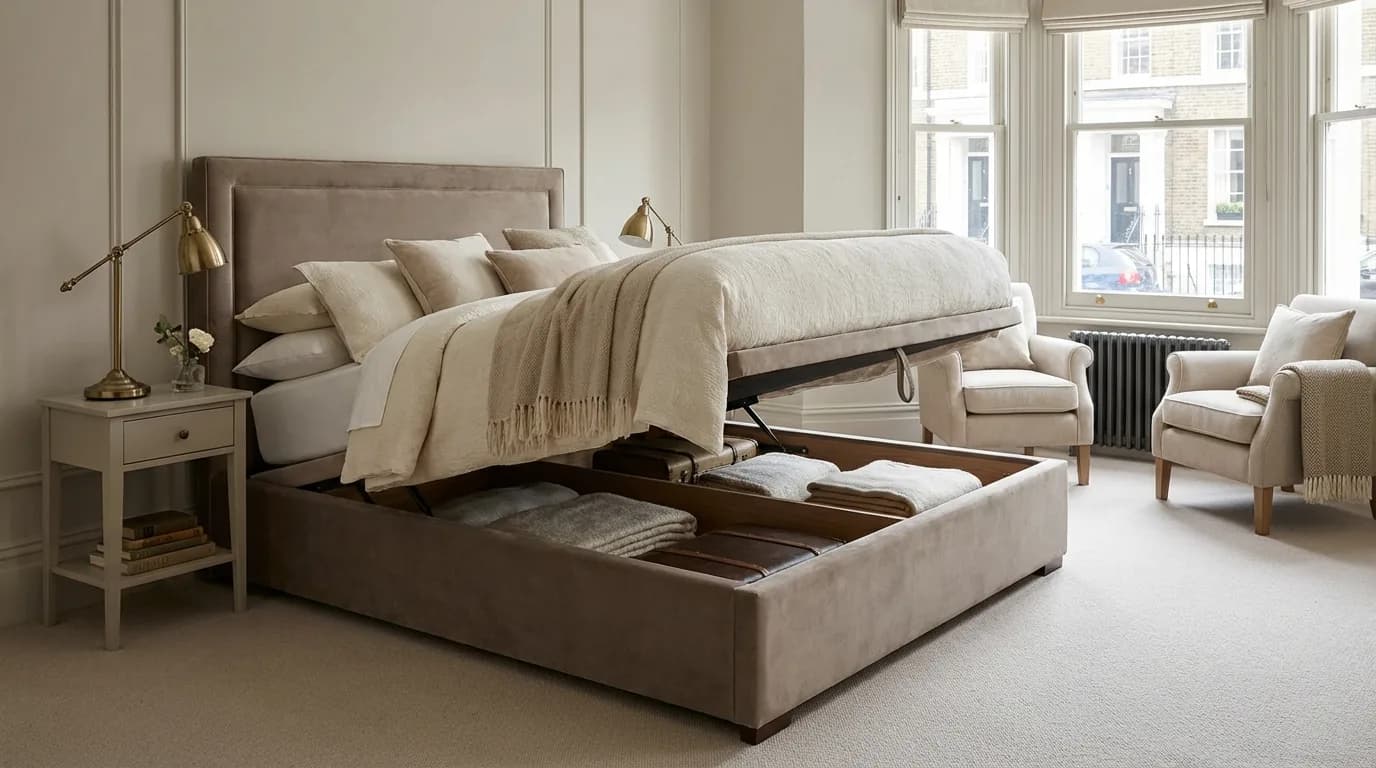
I've spent the better part of a decade helping people furnish bedrooms, and if there's one product category that's genuinely changed the game for UK homeowners, it's the storage bed. Not in a flashy, Instagram-reel kind of way — in a practical, "where on earth do I put four sets of winter bedding in a two-bed terrace?" kind of way.
This guide covers everything you need to know before buying one: the different mechanisms, real-world storage capacities, materials, sizes, and the honest trade-offs nobody else mentions.
Why Storage Beds Are Booming in UK Bedrooms#
The average UK bedroom measures around 11.5 square metres. That sounds generous until you account for a wardrobe, bedside tables, a chest of drawers, and — if you're lucky — a dressing table. Floor space disappears fast, and the traditional solution (shoving vacuum bags under a divan) is about as elegant as it sounds.
Storage beds solve the problem by turning dead space into usable volume. The area underneath your mattress — roughly 150cm x 200cm for a king — becomes a proper compartment. We're talking hundreds of litres that would otherwise just be sitting there collecting dust bunnies.
The UK market has caught on. According to the British Furniture Association, upholstered bed sales overtook traditional divan sets in 2023, and storage variants now account for nearly a third of all bed frame sales online. The reasons are straightforward:
- Smaller new-builds — the average new-build bedroom in England is 15% smaller than one built in the 1970s
- Rising cost per square foot — every cubic metre of storage you can reclaim from existing furniture is money saved on a bigger property
- Better mechanisms — gas-lift technology has matured to the point where a single person can lift a king-size mattress base with one hand
- Aesthetic improvements — storage beds used to look like medical equipment; modern designs in velvet, linen, and solid wood are genuinely beautiful
This isn't a passing trend. When living space shrinks and property costs rise, furniture that works harder earns its keep.
Ottoman vs Drawer vs Lift-Up: Storage Bed Types Explained#
The term "storage bed" covers three fundamentally different designs. Choosing the wrong type is the most common mistake I see, so let's break them down properly.
Ottoman (foot-end lift)#
This is the most popular type in the UK right now, and for good reason. The entire mattress platform lifts from the foot end on gas struts, revealing one enormous cavity. No dividers, no awkward corners — just a big open space. You can fit suitcases, spare duvets, pillow sets, and seasonal clothing in a single lift.
The trade-off? You need clearance at the foot of the bed (at least 30cm to the wall) and a mattress that isn't excessively heavy. Most gas strut systems are rated for mattresses up to 50-60kg, which covers the vast majority of pocket sprung and memory foam options.
Drawer divan#
The traditional option. Two or four drawers built into a divan base, accessed from the side. Storage capacity is much lower — you're looking at 40-80 litres total across all drawers — but access is easier for everyday items like pyjamas, spare phone chargers, or books.
The catch is that you need clear floor space beside the bed for the drawers to open. In a tight bedroom where the bed is pushed against a wall, drawers on that side become useless.
Side-lift ottoman#
Identical in concept to the foot-end ottoman, but the base lifts from one side. This is the specialist choice for rooms where the bed sits with its foot end against a wall or window. Less common, slightly more expensive, but solves a specific layout problem brilliantly.
If you're torn between ottoman and drawer, ask yourself one question: am I storing things I reach for daily, or things I put away for months? Daily access favours drawers. Seasonal storage favours an ottoman every time.
King Size Storage Beds: What to Know Before You Buy#
A king-size storage bed (150cm x 200cm) is the sweet spot for couples. The storage cavity underneath is large enough to be genuinely useful — typically 180-250 litres depending on the frame depth — and the sleeping surface is wide enough that you're not fighting for duvet territory at 3am.
Here's what to watch for:
Weight capacity matters more than you think. The gas struts need to lift your mattress reliably thousands of times over the bed's life. A king-size pocket sprung mattress weighs 35-55kg. Add a mattress topper and fitted sheet and you're pushing 45-65kg. Check the manufacturer's stated limit and leave a margin — if your mattress weighs 50kg, you want a frame rated for at least 60kg.
Measure your staircase, not just your bedroom. A king storage bed frame typically arrives in 3-5 flat-pack pieces, with the largest being the headboard and the base panels. The headboard for a 150cm-wide bed will be at least 155cm across. If you live in a Victorian terrace with a narrow turning staircase, measure the landing turn. I've seen delivery teams have to pass headboards through bedroom windows — not ideal.
Frame depth determines storage volume. A shallow frame (25cm internal depth) gives you around 150 litres. A deep frame (35cm) pushes past 220 litres. The deeper the frame, the higher the overall bed sits — which can look imposing in a low-ceilinged room but is easier on the knees for getting in and out.
Slatted vs solid base. Some storage beds use a slatted mattress platform; others use a solid board. Slatted is better for mattress ventilation (important for memory foam), while solid is stronger and prevents small items falling through into the cavity. The best designs use close-spaced slats with a fabric lining underneath — ventilation without the gaps.
Double Storage Beds: The Most Popular Choice#
The double (135cm x 190cm) remains the UK's best-selling bed size, and the storage variant is no exception. It fits comfortably in bedrooms as small as 2.7m x 3m with room for bedside tables on both sides.
Storage capacity in a double is roughly 130-200 litres — slightly less than a king, but still enough for 3-4 spare duvet sets, a couple of suitcases, or a full season's worth of clothing in vacuum bags.
Double storage beds are particularly popular in:
- Rental properties where tenants can't add built-in wardrobes
- Spare bedrooms that double as home offices — tuck the guest bedding away invisibly
- First homes where the bedroom is functional but compact
One consideration specific to doubles: the shorter length (190cm vs 200cm for a king) means the storage cavity is also shorter. If you're planning to store full-size suitcases, measure them first — a large cabin bag (56cm) fits easily, but a checked suitcase (75cm+) may need to go in diagonally.
Single Storage Beds: Perfect for Kids' Rooms & Guest Rooms#
Single storage beds (90cm x 190cm) don't get talked about enough. The storage cavity is smaller — 80-120 litres — but in a child's bedroom, that's enough for an entire season of outgrown clothes, spare bedding, or the board game collection that's otherwise cluttering the wardrobe floor.
For kids' rooms specifically, I'd recommend drawer divans over ottomans. A child can pull open a drawer safely and independently. An ottoman mechanism, even with gas struts, involves lifting a mattress platform that's awkward for small hands — and there's always the (small but real) risk of it closing unexpectedly if the struts weaken over time.
For guest rooms, a single ottoman makes more sense. You're storing spare bedding and towels that get accessed a few times a year, not daily. The full-cavity access of an ottoman makes it easy to pack everything in neatly and forget about it until the next visitor arrives.
How Much Storage Do You Actually Get?#
Manufacturers love to throw around storage capacities without context, so let's make the numbers real.
For reference, a standard 10.5-tog king duvet compressed into a vacuum bag takes up roughly 15-20 litres. A set of four pillows in a vacuum bag is another 10-15 litres. A medium suitcase sits at about 60-70 litres of displaced space.
The most efficient way to use ottoman storage is with vacuum compression bags for soft items and stackable boxes for smaller things. Avoid just throwing loose items in — you'll waste 30-40% of the capacity on air gaps.
A 200-litre ottoman bed replaces approximately one full chest of drawers (120-150 litres) in effective storage capacity. If your bedroom currently has a chest of drawers purely for bedding and seasonal items, a storage bed could let you remove it entirely and reclaim that floor space.
Materials: Velvet, Fabric, Faux Leather & Solid Wood#
The material you choose affects how the bed looks, how it ages, and how much maintenance it needs. Here's the honest breakdown:
Velvet#
Velvet storage beds have dominated the UK market since around 2020, and the appeal is obvious — they look expensive, feel luxurious, and photograph beautifully. The pile catches light in a way that gives depth and richness to any bedroom.
The practical truth: velvet shows marks. Spill a glass of water and you'll get a tide mark unless you blot it immediately. Pet hair sticks to it enthusiastically. The pile can crush over time, especially where you sit on the edge of the bed to put shoes on. That said, modern crushed-velvet and plush-velvet fabrics are more forgiving than traditional silk velvet — they're designed for upholstery, not ball gowns.
If you want velvet but worry about durability, look for a polyester velvet rather than viscose. Polyester velvet is more stain-resistant, holds its pile better, and is significantly easier to clean with a damp cloth.
Woven fabric (linen-look, boucle, chenille)#
The practical choice. Woven fabrics hide marks better than velvet, resist pilling, and age gracefully. Linen-look polyester is the workhorse of the upholstered bed world — it's durable, wipeable, and comes in a range of neutral tones that work with almost any bedroom scheme.
Boucle and chenille are textural alternatives that add visual interest without the high-maintenance aspects of velvet. They're particularly good in guest bedrooms where the bed needs to look inviting but won't get the daily wear of a master bedroom.
Faux leather#
Wipe-clean, hard-wearing, and polarising. Some people love the sleek look; others find it cold. Faux leather is at its best in modern, minimalist bedrooms and at its worst in traditional or cottage-style rooms.
The practical advantages are real: it cleans instantly, doesn't harbour dust mites, and won't absorb spills. The disadvantage is that it can crack and peel after 5-7 years, especially cheaper PU variants. If you go faux leather, invest in PVC-backed faux leather or look for a brand that specifies its material won't crack.
Solid wood#
Wooden storage beds are typically drawer-style rather than ottoman. They're heavier, more expensive, and harder to move, but they last decades and have a warmth that upholstered beds can't match. Oak, pine, and walnut are the most common UK options.
Gas Lift Mechanisms: Are They Reliable?#
This is the question everyone asks and nobody gives a straight answer to. So here it is: yes, gas lift mechanisms are reliable — provided the bed is well-made.
A quality gas strut (sometimes called a gas spring or pneumatic lift) is rated for 10,000-30,000 cycles. If you open your bed once a day, that's 27-82 years of use. In practice, most people open a storage bed a few times a week at most, so you're looking at a lifetime of trouble-free operation from decent struts.
Where problems arise:
- Cheap struts — budget beds (under £400) sometimes use lower-grade gas struts that lose pressure after 2-3 years. The mattress platform still lifts, but it won't stay up on its own — you end up propping it with a pillow, which defeats the purpose.
- Overloaded mattresses — if your mattress exceeds the weight limit, the struts work harder than designed and fail sooner.
- Incorrect installation — gas struts must be mounted at the correct angle. A badly assembled bed can put lateral stress on the struts that causes premature wear.
The good news: gas struts are replaceable. A pair of replacement struts costs £30-£60 and takes about 20 minutes to swap. It's not a reason to avoid a storage bed — it's a maintenance item, like changing a door hinge.
When testing a storage bed in a showroom or after assembly, lift the platform with one hand. If it rises smoothly and stays open without you holding it, the struts are correctly rated. If it feels heavy or drifts back down, the struts are either too weak for the mattress on display or are already worn.
Our Pick: The Chelsea Velvet King Storage Bed#
After reviewing dozens of storage beds across every price point, the one I keep coming back to is our own Chelsea.

The Chelsea Storage Bed
£1,399
A king-size upholstered bed with a fully-lifting mattress base — the entire frame opens silently on gas struts to reveal 200 litres of hidden storage for seasonal bedding and more. Deep-buttoned velvet headboard, kiln-dried hardwood frame. Three classic velvet colours.
The Chelsea is a king-size ottoman bed with a deep-buttoned velvet headboard and a full lift-up base. Here's why it stands out:
200 litres of genuine storage. That's not a marketing number — it's the measured internal volume of the cavity. Enough for four sets of bedding, two suitcases, and still have room left over. The base lifts smoothly on heavy-duty gas struts and holds position hands-free while you organise.
Kiln-dried hardwood frame. This matters more than people realise. Softwood frames warp over time, especially in centrally heated UK homes where humidity fluctuates seasonally. Kiln-dried hardwood is dimensionally stable — the frame won't creak, shift, or develop gaps at the joints.
Three velvet colours that actually work. Mink, Forest, and Navy. These aren't random — they're the three tones that work with the widest range of bedroom schemes. Mink is the safe neutral that goes with everything. Forest is for anyone who wants character without committing to something bold. Navy is the classic choice that reads as sophisticated without being dark.
The headboard is properly deep-buttoned. Not tufted with buttons glued on (the budget approach) — genuine deep buttoning where the fabric is pulled through the padding and secured from behind. It creates real depth and shadow that flat headboards can't match.
At £1,399 it sits in the mid-premium range — more than a budget ottoman from a flat-pack retailer, but significantly less than equivalent beds from premium high-street brands. The frame carries a 2-year structural guarantee, and the gas struts are standard-gauge replacements available from any hardware supplier.
Assembly is honest. It takes about 45 minutes with two people. The instructions are clear, the hardware is labelled, and nothing requires specialist tools. It's not a 10-minute job — don't let anyone tell you otherwise — but it's well within DIY territory.
Browse our full bedroom collection at /search/bedroom for more options.
Frequently Asked Questions#
Can I use any mattress with a storage bed?#
Yes, with one caveat: check the weight limit. Most ottoman storage beds are designed for mattresses weighing up to 50-60kg. A standard king-size pocket sprung mattress weighs 35-50kg, so you're fine. Heavier mattresses — like some natural latex models that can reach 70kg+ — may exceed the limit and cause the gas struts to struggle. Always check the spec sheet.
How do I stop a storage bed from smelling musty?#
The enclosed cavity can trap moisture, especially in winter when bedrooms are heated. Two simple fixes: first, leave the bed open for an hour every couple of weeks to air out. Second, drop a few silica gel packets or a small dehumidifier sachet into the cavity. Cedar balls work well too and keep moths away from stored clothing.
Are storage beds suitable for people with back problems?#
Generally, yes — the mattress support is the same as a non-storage bed. The only consideration is the lifting mechanism. If bending to lift the foot-end panel is difficult, look for a side-lift ottoman or a drawer divan where you access storage from a standing position. The sleeping surface itself is identical.
How long do gas struts last on a storage bed?#
Quality gas struts are rated for 10,000-30,000 cycles. With typical use (opening a few times per week), that translates to 15-40+ years. If they do eventually lose pressure, replacement struts cost £30-£60 and take 20 minutes to fit — it's a maintenance item, not a reason to replace the entire bed.
Can I put a TV at the foot of a storage bed?#
You can, but be mindful of clearance. A foot-end ottoman needs the platform to swing upward, which requires approximately 30-50cm of clear space beyond the foot of the bed. If a TV unit is pushed right up against the frame, you won't be able to open the storage. Either leave a gap or choose a side-lift variant.
Is a storage bed worth the extra cost over a standard bed frame?#
In most UK bedrooms, yes. A storage bed typically costs £200-£400 more than an equivalent non-storage frame. A standalone chest of drawers providing similar capacity costs £150-£300 and takes up 0.5-0.8 square metres of floor space. If your bedroom is tight on space, the storage bed pays for itself by eliminating the need for a separate storage unit — and you get that floor space back for a bedside table, reading chair, or simply room to move.