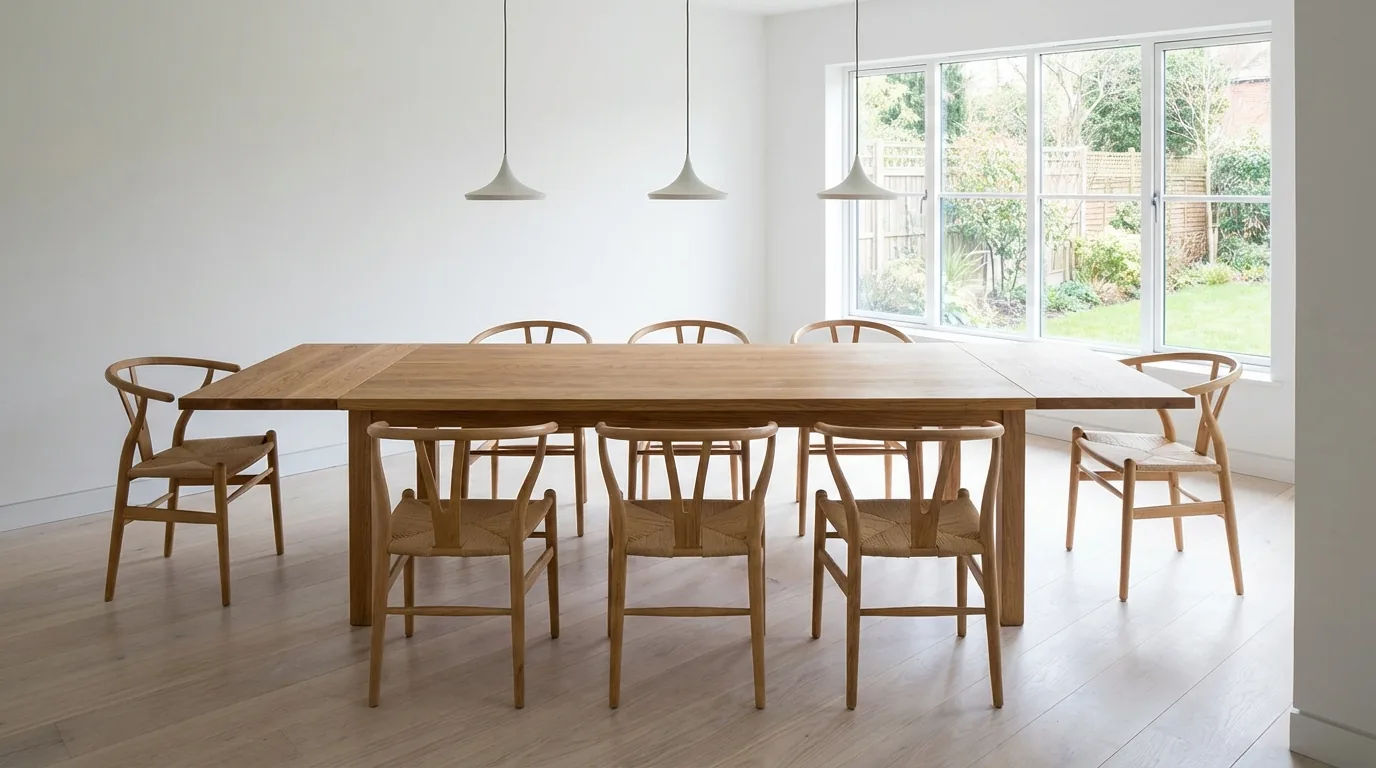
Extending Dining Tables: Oak vs Walnut vs Pine#
I have always thought the extending dining table is one of the most underrated pieces of furniture in a British home. Most of the week, it seats four or six for weeknight dinners where someone is probably eating with one eye on their phone. Then Saturday evening arrives, or Christmas, or the in-laws descend without much warning, and suddenly you need room for eight or ten. An extending table handles both realities without asking you to sacrifice your kitchen floor space to a permanently oversized slab of wood.
But the material you choose matters enormously. Oak, walnut, and pine are the three woods you will encounter most often in the UK market, and they differ in hardness, grain character, price, and how they age over decades of daily use. This guide breaks down each option honestly, covers the mechanisms that make extending tables work, and includes a practical size guide so you can buy with confidence.
Why an Extending Dining Table Is the Smartest Buy for UK Homes#
British homes are not getting bigger. The average new-build has less floor space than at any point since the 1930s, and Victorian terraces, as charming as they are, were not designed for open-plan living. Space is the constraint that defines most furniture decisions in this country.
A fixed dining table forces a compromise. Either it is big enough for entertaining and dominates the room six days a week, or it is compact enough for daily life and you are scrambling for a pasting table when guests arrive. Neither situation is ideal.
An extending table eliminates that compromise. A well-designed model takes up no more footprint than a standard four-seater when closed, then gains 40 to 120 cm of additional length in seconds. No separate leaves to store in a cupboard, no wrestling with heavy inserts, no wobbly improvised extensions. The mechanism does the work.
The practical benefits go beyond entertaining. A compact table that extends becomes a home office during the day, a homework station after school, and a dinner table in the evening. I know families who extend their table every morning for remote work and close it again before dinner. The versatility justifies the modest price premium over a fixed equivalent.
From a financial perspective, extending models typically cost 100 to 300 pounds more than a comparable fixed table in the same wood. Given that the alternative is buying two tables, or buying one that is too big and regretting it, the extension mechanism pays for itself almost immediately.
How Extending Mechanisms Work: Butterfly Leaf, Draw Leaf & Self-Storing#
The mechanism is what separates a good extending table from a frustrating one. There are three common types in the UK market, and each has distinct advantages.
Butterfly Leaf#
This is the most popular mechanism in the UK market and for good reason. The leaf is permanently attached to the underside of the table. You pull the two halves of the table apart, the leaf swings up on hinges, and you push the halves back together. The leaf clicks into place flush with the main surface. No separate pieces to store, no heavy lifting. One person can do it in ten seconds.
The downside is that the extension is typically limited to a single leaf of 40 to 60 cm. If you need to add more than two extra seats, a draw-leaf mechanism offers more range.
Draw Leaf#
Common on traditional and farmhouse-style tables. Two leaves are stored beneath the main tabletop, one at each end. You pull a handle or grip the leaf edge and slide it out. The main top then drops down to sit flush. Each leaf typically adds 40 to 50 cm, so a double-extension draw leaf can add nearly a full metre of table length.
The mechanism is robust and rarely fails because there are few moving parts, just wooden runners. The trade-off is that draw-leaf tables tend to be heavier and bulkier, even when closed, because they need to house two full-width leaves underneath.
Drop-In Leaf#
The most traditional approach. The table separates in the middle and you manually place one or more leaf panels into the gap. The panels are stored separately, typically leaning against a wall or in a cupboard. This gives you maximum flexibility since you can add one leaf or two, but it requires storage space and at least two people to handle the panels comfortably. Best suited to formal dining rooms where the table is extended only for special occasions.
When testing an extending mechanism in a showroom, operate it yourself. Do not let the sales assistant do it. You need to know how much force it takes, whether the runners stick, and whether the extended surface sits genuinely flush. A mechanism that is stiff in a heated showroom will be stiffer in a cold kitchen.
Oak Extending Tables: Pros, Cons & What to Expect#
Oak is the default choice for extending dining tables in the UK, and that is not just tradition talking. It is one of the hardest domestic hardwoods available, with a Janka hardness rating of 1,360 pounds-force. That translates directly to scratch resistance, dent resistance, and longevity under the daily punishment of family meals.
Why Oak Works#
The grain pattern is distinctive and characterful. European oak has a prominent, open grain with medullary rays that catch the light, giving the surface a depth and movement that photographs cannot fully capture. It ages beautifully. Over the years, natural oak darkens slightly to a warm honey tone, while oiled finishes deepen and enrich the colour.
Oak is also remarkably stable for a hardwood. Kiln-dried oak moves less with humidity changes than many alternatives, which matters for an extending table where the mechanism relies on precise tolerances. A table that swells in a damp kitchen or shrinks in a centrally heated dining room will have a mechanism that sticks or gaps.
What to Watch For#
Oak is heavy. A solid oak extending table for six to eight people can weigh 60 to 90 kg, which makes repositioning it a two-person job. If you are likely to move the table regularly, perhaps between a kitchen and a dining room, consider oak veneer on a lighter engineered core. The surface looks identical; the weight drops by 30 to 40 percent.
Price is the other consideration. Solid European oak extending tables start around 800 pounds for basic models and climb to 2,500 pounds or more for hand-finished pieces from specialist workshops. The sweet spot for quality and value sits between 1,000 and 1,500 pounds, where you get genuine solid timber, a reliable mechanism, and a finish that will last.
Solid oak and oak-veneer are not the same thing, but both can be excellent choices. Solid oak can be sanded and refinished multiple times over its lifetime. Oak veneer over a stable engineered core is lighter, often cheaper, and still looks identical. The trade-off is that deep scratches on veneer cannot be sanded out without cutting through to the substrate. For most families, a quality veneer is perfectly practical.
Walnut Extending Tables: The Premium Choice#
If oak is the workhorse, walnut is the showpiece. European and American walnut both have a rich, dark grain with swirling figuring that makes every table unique. It is the choice for people who want their dining table to be the centrepiece of the room, not a functional backdrop.
The Appeal of Walnut#
The colour is walnut's defining feature. Deep chocolate browns, sometimes with purple or grey undertones, and a grain that ranges from straight to dramatically figured. Walnut has a natural lustre that oak lacks, giving it a slightly more formal, contemporary feel. In a room with white walls and modern cabinetry, a walnut table becomes an anchor piece.
Walnut is softer than oak, with a Janka rating of 1,010 versus oak's 1,360. In practice, this means it will pick up dents and scratches more readily. Some people consider this a feature rather than a bug. Walnut develops a patina over time that many owners find adds character. If you are the type who puts coasters down and uses placemats, walnut will stay pristine. If you are not, it will tell the story of every family meal, which is its own kind of beauty.
The Cost Question#
Walnut is genuinely expensive. The raw timber costs significantly more than oak because walnut trees grow more slowly and yield less usable wood per trunk. A solid walnut extending table typically costs 20 to 40 percent more than an equivalent oak model. Expect to pay 1,200 to 3,000 pounds for a solid walnut extending table that seats six to eight.
For many buyers, walnut veneer over an engineered core offers the aesthetic at a more accessible price point, typically 800 to 1,500 pounds. The surface is real walnut, the colour and grain are genuine, and the weight is more manageable.
Walnut and Light#
One thing to be aware of: walnut changes colour over time. Unlike oak, which darkens, walnut actually lightens with UV exposure. A table that starts as deep chocolate will gradually shift towards a warmer, lighter brown over five to ten years. This is natural and not a defect, but it means a walnut table that sits in a sunny south-facing kitchen will look noticeably different after a few years compared to one in a north-facing dining room. Some owners embrace this; others prefer to position the table away from direct sunlight.
Pine Extending Tables: Budget-Friendly but Is It Durable?#
Pine is where the honest conversation needs to happen, because pine extending tables are by far the most affordable option and they sell in enormous quantities. Whether they are the right choice depends entirely on your expectations.
The Case for Pine#
Pine is a softwood, and it costs a fraction of what oak or walnut commands. A solid pine extending table can be found for 300 to 700 pounds, which is genuinely accessible for first-time buyers, renters, and young families. The grain is lighter and more uniform than oak, with a pale, creamy colour that suits Scandinavian-inspired and farmhouse-style interiors.
Pine is also significantly lighter than oak. A pine extending table for six weighs roughly 30 to 45 kg versus 60 to 90 kg for oak. If you need to move your table regularly, or if you are carrying it up a narrow staircase, that weight difference matters.
The Case Against Pine#
Pine has a Janka hardness rating of just 380 to 690 (depending on the species), which is less than half of oak's. It dents if you drop a mug on it. It scratches if you drag a plate across it. Rings from hot cups appear almost immediately on unprotected surfaces. If you have young children, the table surface will show every impact within months.
This is not necessarily a dealbreaker. Many people buy pine specifically because they expect it to develop character. The farmhouse aesthetic embraces wear. But if you want a table that still looks crisp and unmarked after five years of family meals, pine will not deliver that.
Pine also has a tendency to yellow over time, particularly in bright rooms. The pale, fresh look that attracts buyers in the showroom will shift to a darker, more amber tone within two to three years. You can delay this with UV-protective finishes, but you cannot prevent it entirely.
Be cautious with pine extending tables at the very bottom of the market, under 300 pounds. These are often constructed from finger-jointed pine offcuts with thin lacquer finishes. The extending mechanism may use plastic runners instead of hardwood or metal, which can fail under load. A slightly higher spend on a properly constructed pine table will last significantly longer.
Size Guide: How Big Do You Need When Extended?#
Getting the dimensions right is more important than choosing the wood. A beautiful table that is too big for the room or too small for your guests is a failure regardless of the material.
Here are the measurements that work, based on allowing 60 cm of table width per person for comfortable elbow room and 90 cm of clearance around the table for chairs and walkways.
A few practical notes on these numbers. The 90 cm clearance around the table is the minimum for pulling a chair back and walking past someone who is seated. In a kitchen-diner where one side of the table is against a wall, you obviously need clearance on three sides only. In an open-plan space, you need it on all four.
Round extending tables follow different rules. A 120 cm diameter round table seats four comfortably and extends to an oval seating six. Round-to-oval mechanisms typically add 40 to 50 cm of length. For rooms that are more square than rectangular, a round extending table often uses the space more efficiently than a rectangular one.
Before ordering, lay masking tape on the floor in both the closed and extended dimensions. Live with it for a day. Walk around it, pull out imaginary chairs, check you can open the oven door or the dishwasher. This five-minute exercise has saved more people from expensive mistakes than any measurement guide.
Caring for Solid Wood: Oiling, Cleaning & Protection#
Whichever wood you choose, the daily care routine is essentially the same. The finish type determines the specifics.
Oiled Finishes#
Many high-quality oak and walnut tables come with a hand-oiled finish. Oil soaks into the wood grain rather than sitting on top, giving a natural, matte look that lets you feel the texture of the wood. The trade-off is that oil needs reapplying.
For a table in daily use, apply a fresh coat of furniture oil every six to twelve months. Use a product specifically designed for dining tables (food-safe, hardening oil like Danish oil or hard wax oil). Apply a thin coat with a lint-free cloth, leave for 20 minutes, then buff off the excess with a clean cloth. The process takes about 30 minutes and the table is usable again within a few hours.
Between oiling, wipe spills immediately. Oiled wood is not sealed, so liquids left standing will soak in and leave marks. Use placemats and coasters consistently. If a watermark does appear, a light sand with 400-grit paper followed by a spot application of oil will usually remove it.
Lacquered Finishes#
Lacquer creates a sealed, protective film on the wood surface. It is more resistant to spills and heat than oil and requires less maintenance. The downside is that lacquer can chip or peel over time, and repairing damage is harder than with an oiled finish since you need to strip and re-lacquer rather than simply re-oiling.
For lacquered tables, wipe with a damp cloth and mild soap. Avoid abrasive cleaners or scouring pads. Use trivets for hot dishes, as extreme heat can cause the lacquer to bubble or discolour. If the lacquer dulls over years of use, a professional refinish restores it completely.
Pine-Specific Care#
Pine deserves extra attention because of its softness. Always use placemats, coasters, and a tablecloth or runner for protection. Consider a hard wax oil finish, which penetrates the soft grain and provides better protection than a surface-level lacquer. Wax finishes can be spot-repaired easily when dents and scratches inevitably appear.
For the extending mechanism on any wood table, apply a thin coat of beeswax or candle wax to the wooden runners once or twice a year. This keeps the mechanism smooth and prevents the wood-on-wood contact from wearing or sticking in damp conditions.
Our Pick: The Hampton Solid Oak Extending Dining Table#
For the combination of build quality, mechanism reliability, and everyday practicality, the Hampton is the table I would recommend to anyone considering an oak extending dining table.
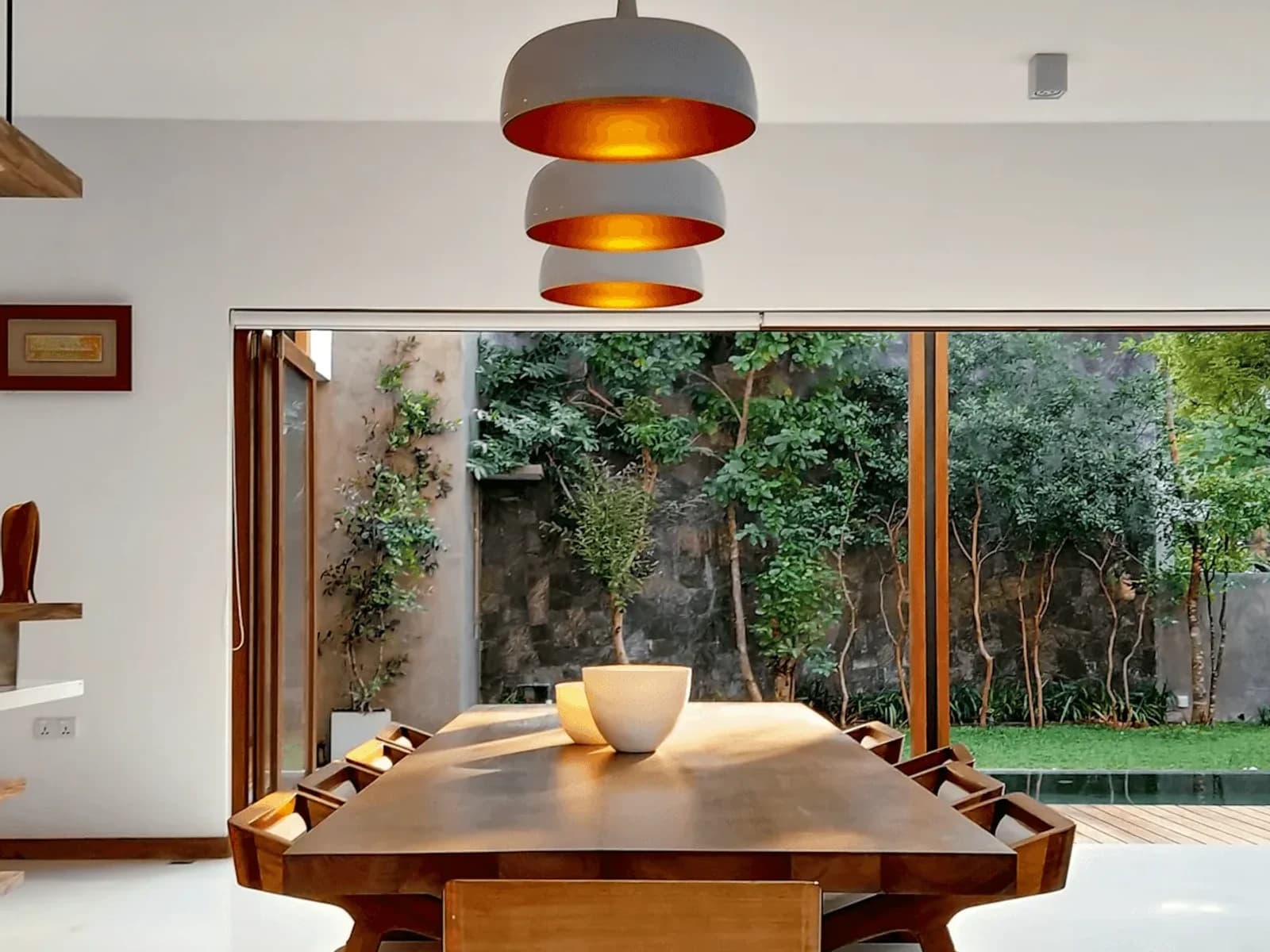
The Hampton Dining Table
£1,299
A solid oak extending dining table that grows with your gatherings. Start as a six-seater for weeknight dinners, extend in seconds to seat eight for Sunday lunch. Hand-finished with natural oils that let the grain breathe, on a kiln-dried hardwood base. Three warm finishes.
The Hampton is built from solid European oak, kiln-dried for stability, and hand-finished with natural oils that let the grain breathe. It seats six as standard and extends to seat eight in seconds. The extension mechanism is smooth and robust, the kind you can operate one-handed without fighting the runners.
Available in three finishes: Natural Oak for a classic, honey-toned look; Walnut for something darker and more contemporary; and Ash for a paler, Scandinavian-leaning aesthetic. All three are the same solid oak timber with different oil treatments, so you get the same hardness and durability regardless of the colour you choose.
At 1,299 pounds, the Hampton sits at the sweet spot I mentioned earlier, genuine solid timber, a reliable mechanism, and a finish that will improve with age rather than deteriorate. Free UK delivery in 7 to 10 days with two-person room-of-choice placement. Assembly is minimal: legs bolt on in under ten minutes with the included Allen key.
For broader guidance on choosing the right table shape, size, and style, read our complete dining table guide.
Frequently Asked Questions#
Is oak or walnut better for a dining table?#
Oak is harder (Janka 1,360 vs walnut at 1,010), more scratch-resistant, and typically 20 to 30 percent cheaper. It suits busy family kitchens where durability matters most. Walnut has a richer, darker grain with natural figuring that makes it visually striking, better suited to formal dining rooms or contemporary spaces where the table is the centrepiece. Both woods last decades with proper care. If you have young children, oak's extra hardness gives it the edge. If aesthetics are your priority and you are happy using placemats, walnut is the more dramatic choice.
How does the extending mechanism work on a dining table?#
The three most common mechanisms are butterfly leaf, draw leaf, and drop-in leaf. A butterfly leaf is stored beneath the tabletop and flips up when you pull the table apart, locking into place in seconds. A draw leaf slides out from under each end of the main top. A drop-in leaf is a separate panel that you place into the gap manually. Butterfly-leaf mechanisms are the most convenient for daily use because nothing is stored separately and one person can operate them in under ten seconds.
Are pine dining tables durable enough for everyday use?#
Pine is a softwood with a Janka hardness rating roughly half that of oak. It will dent and scratch noticeably from daily use, especially with children. It is best suited to informal, farmhouse-style kitchens where wear adds character rather than detracting from the look. Use placemats, coasters, and a hard wax oil finish to protect the surface. Pine tables cost 40 to 60 percent less than hardwood equivalents, making them excellent value for renters, first homes, or anyone who plans to upgrade in five to ten years.
How many extra people can an extending dining table seat?#
Most extending tables add 40 to 60 cm of length with a single leaf, which seats two additional people. Tables with double-extension mechanisms (draw leaf or twin butterfly) can add 80 to 120 cm, seating four more. The Hampton Extending Dining Table extends from a six-seat to an eight-seat configuration in seconds. When calculating capacity, allow 60 cm of table width per person for comfortable elbow room.
Do extending dining tables wobble when extended?#
Quality extending tables with butterfly-leaf or draw-leaf mechanisms are stable when extended. The key factors are the base design and the locking mechanism. Tables with central pedestal bases or twin pedestal bases tend to be more stable than four-legged designs when extended, because the support points do not change position. Always test the table in its extended position before buying. If it rocks or flexes, the mechanism or base design is inadequate. Look for locking catches that hold the leaf firmly in place with zero play.
How do I maintain the extending mechanism?#
Apply a thin coat of beeswax or candle wax to the wooden runners once or twice a year. This prevents wood-on-wood friction from making the mechanism stiff, which is particularly important in kitchens where humidity fluctuates with cooking. Check that all locking catches engage properly and tighten any loose fittings. If the mechanism becomes stiff despite waxing, lightly sand the runners with 400-grit paper to remove any rough spots, then re-wax. Never use oil or WD-40 on wooden runners as it can soak into the grain and cause swelling.