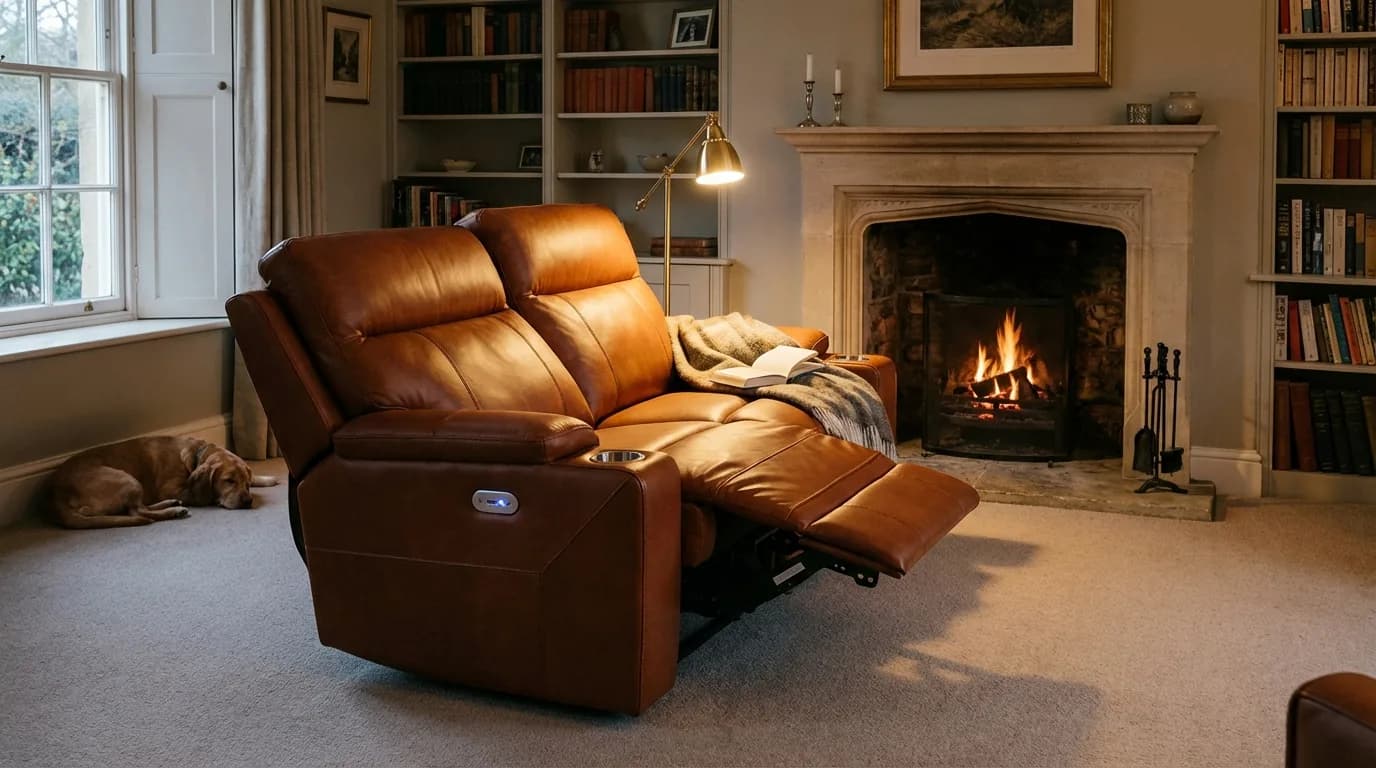
I'll be honest: I was a recliner sceptic for years. They reminded me of my grandad's chair — beige, bulky, and wedged into the corner of a 1980s lounge with a doily on the headrest. But the category has moved on dramatically, and modern electric recliners are a different proposition entirely. Slimmer profiles, silent motors, USB charging, powered headrests — the engineering is genuinely impressive.
This guide covers the full picture: how the mechanisms work, fabric vs leather, the features worth paying for, sizing considerations, wall clearance (the question everyone forgets to ask), and honest maintenance advice.
Manual vs Electric Recliner: Why Electric Wins#
Let's get the obvious question out of the way first. Manual recliners still exist, they're cheaper, and they work. So why would you spend more on an electric?
The real advantage of electric isn't laziness — it's precision. A manual recliner clicks between two or three fixed positions. An electric recliner stops exactly where you want it. Watching a film? Recline 80% with the headrest tilted forward. Reading? Recline 30% with feet slightly raised. Napping? Go fully flat. You find the position that's actually comfortable rather than compromising with whichever fixed notch is closest.
For anyone with mobility issues, joint problems, or back pain, the difference is transformative. Returning to upright from a manual recliner requires bracing your legs and pushing — not ideal if your knees aren't what they used to be. An electric does it for you at the press of a button.
Many occupational therapists recommend electric recliners for clients with mobility challenges, as the powered mechanism removes the physical effort of reclining and returning to upright. The controlled, smooth motion puts less stress on joints than the sudden movement of a manual mechanism.
How Electric Recliner Mechanisms Work#
Understanding the mechanism helps you buy smarter and troubleshoot if something ever goes wrong. Here's what's inside:
The motor. A small linear actuator (essentially an electric motor driving a threaded rod) sits underneath each reclining seat. When you press the button, the motor extends or retracts the rod, which pushes or pulls the footrest and backrest through a metal linkage. Quality motors run at around 29V DC (reduced from mains via a transformer) and draw very little power — less than a bedside lamp.
The transformer. A small black box that plugs into your wall socket and converts 240V mains to the low-voltage DC the motors need. It typically sits on the floor behind or underneath the sofa with a 2-3 metre cable. One transformer can power multiple seats — a 3-seater with three independent recliners usually has one transformer with a daisy-chain cable.
The control. Either a wired button panel (usually two buttons: one for the footrest, one for the backrest) or a wireless remote. Wired is more reliable; wireless is more convenient. Some premium models use touch-sensitive panels integrated into the armrest.
The linkage. A metal scissor mechanism that translates the linear push-pull of the motor into the arc of the footrest lifting and the backrest reclining. This is the same basic geometry as a manual recliner, just motor-driven instead of spring-loaded.
The whole system is simpler than it looks. There are no circuit boards to fail, no software to crash, no Bluetooth to disconnect. It's motors, cables, and metal. That's part of why electric recliners are more reliable than people expect — the technology is fundamentally mechanical.
Fabric vs Leather for Recliner Sofas#
This is the single biggest decision after size, and it affects comfort, maintenance, aesthetics, and longevity.
Fabric recliners#
Fabric is the more popular choice in the UK, and for good reason. It's warmer in winter (leather is cold to the touch until it absorbs body heat), breathes better in summer, and comes in a wider range of colours and textures. For a family recliner that gets daily use, a good-quality woven fabric — chenille, brushed polyester, or a linen-blend — is hard to beat.
The practical considerations:
- Stain resistance — look for fabrics with a factory-applied stain guard (Scotchgard or equivalent). It won't make the fabric bulletproof, but it buys you time to blot spills before they set.
- Pilling — cheaper polyester fabrics can pill on the seat and headrest after 6-12 months of heavy use. Ask about the Martindale rub count — anything above 25,000 is suitable for domestic furniture. Above 40,000 is excellent.
- Removable covers — some fabric recliners have zip-off seat covers that can be machine-washed. This is a genuine advantage if you have children or pets. Ask before you buy, because most don't.
Leather recliners#
Leather ages differently. A good leather sofa develops a patina over years — the colour deepens, the surface softens, and it takes on character. A cheap leather sofa cracks, peels, and looks worse with every passing year. The material quality matters enormously.
Full-grain leather is the top tier. It's the outer surface of the hide with all its natural texture intact. It's expensive (expect to pay £1,500+ for a 2-seater), but it's the only leather that genuinely improves with age.
Top-grain leather has been lightly sanded and treated. It's more uniform in appearance and slightly more resistant to staining, but it won't develop the same patina as full-grain.
Split leather / bonded leather is the bottom tier. Split leather is the inner layer of the hide; bonded leather is reconstituted scraps glued together and coated. Both will peel and crack within 3-5 years. Avoid them — you're better off with a good fabric.
If a retailer advertises a leather recliner under £800 for a 2-seater, it's almost certainly bonded or split leather. Ask specifically: "Is this full-grain or top-grain?" If they can't answer clearly, walk away.
For a deeper look at upholstery choices across all sofa types, see our fabric guide.
Power Headrest, Lumbar Support & USB Charging: Features Worth Paying For#
The recliner market is full of feature lists, and not all of them are worth the premium. Here's my honest assessment:
Worth paying for#
Power headrest. A powered headrest tilts independently of the backrest, letting you angle your head forward when watching TV or back when resting. Without it, reclining pushes your head backward and you end up staring at the ceiling instead of the screen. This is the single most useful upgrade on any electric recliner — it costs £100-£200 extra and makes a daily difference.
USB charging ports. A USB-A or USB-C port built into the side of each seat. Sounds gimmicky; turns out to be something you use constantly. No more dangling phone chargers across the living room. The ports draw power from the same transformer that drives the motors, so there's no additional plug needed.
Individual seat controls. On a 2-seater or 3-seater, each seat should recline independently. If one person wants to recline and the other doesn't, they shouldn't have to compromise. This is standard on most electric recliners above £1,000, but check — some budget models link the seats.
Nice to have#
Lumbar support adjustment. A small motor or inflatable bladder in the lower back area. Useful if you have specific back support needs, but most people find that the overall recline angle provides adequate lumbar support without a dedicated mechanism.
Memory positions. Some high-end recliners let you save your preferred recline angle. Press a button and it returns to your exact position. Convenient but not essential — you'll find your favourite angle within a few days and muscle-memory the button hold time.
Skip it#
Built-in speakers / Bluetooth audio. The speakers are invariably small, tinny, and positioned too close to your ears. Your TV speakers or a separate soundbar will always sound better. And Bluetooth adds a failure point — pairing issues, firmware updates, battery drain on wireless variants.
Massage functions. The vibration motors in budget recliner massage units are the same ones used in car seat covers. They buzz rather than massage. If you genuinely want massage functionality, buy a dedicated massage chair — it's a different product category entirely.
LED cup holder lights. I wish I was joking. These exist. They add absolutely nothing except a potential electrical fault point and an ice-blue glow that makes your living room look like a nightclub at 2am.
Recliner Sofa Sizes: 2-Seater, 3-Seater & Corner Configurations#
2-seater electric recliners#
The compact option. A 2-seater electric recliner typically measures 150-170cm wide, 95-100cm deep (when upright), and 100-105cm tall. Both seats recline independently.
This is the best choice for:
- Smaller living rooms and snug rooms
- Dedicated TV/cinema rooms where you want theatre-style seating
- Couples who don't need extra seating for guests
3-seater electric recliners#
The standard family choice. Width runs 200-220cm, with the same depth and height as a 2-seater. On most 3-seaters, the two outer seats recline while the centre seat stays fixed — it's structurally necessary to keep the frame rigid.
Some premium 3-seaters offer all three seats reclining. This requires a more complex (and expensive) frame, and the centre seat recline is usually shorter than the outer seats due to space constraints.
3+2 recliner sets#
A 3-seater and 2-seater sold as a matching pair. This is the most popular configuration in UK living rooms — the 3-seater goes along the main wall, the 2-seater on the side. You get five seats, four of which recline.
Buying as a set typically saves 10-15% compared to purchasing separately, and you're guaranteed the fabric/leather matches perfectly. Colour matching between separate orders — even from the same manufacturer — can be slightly off due to dye batch variations.
Corner recliners#
Corner recliners combine the L-shape layout of a corner sofa with electric recline on the end seats. They're space-efficient (one piece of furniture instead of two) and suit open-plan living rooms where the sofa defines the boundary between living and dining areas.
The trade-off is flexibility. A 3+2 set can be rearranged if you move house or redecorate. A corner unit is committed to its configuration — right-hand or left-hand — and can be difficult to fit through doorways and up staircases as a single piece. Most arrive in modular sections, but check before ordering.
For more on corner configurations, see our corner sofa guide.
Will a Recliner Sofa Fit Against My Wall? (Clearance Measurements)#
This is the question that catches people out. A recliner sofa cannot sit flush against the wall — the backrest needs room to tilt backward when you recline.
Standard wall clearance: 10-15cm. Most electric recliners need a gap of 10-15cm between the back of the sofa and the wall. This allows the backrest to tilt without scraping the wall or skirting board.
"Wall-hugger" or "zero-wall" recliners: 5cm or less. These use a mechanism where the seat slides forward as the back reclines, so the sofa barely moves backward at all. They're the right choice for tight rooms, but be aware that the seat extends further forward when reclined — you need more space in front of the sofa instead.
Here are the real-world measurements to check before you buy:
- Width of the sofa — measure the wall space and leave 5cm either side for breathing room
- Depth when upright — typically 95-100cm from the front cushion edge to the back of the frame
- Depth when fully reclined — typically 140-160cm from the front of the extended footrest to the wall behind. This is the number that matters most
- Height — usually 100-105cm. Check this against window sill heights — a tall-backed recliner in front of a low window looks awkward
- Doorway clearance — measure your living room door. Most 2-seaters fit through a standard 76cm UK doorway on their side. 3-seaters may need the legs removed
Before ordering, tape out the footprint on your living room floor using masking tape. Mark the upright depth AND the reclined depth. Sit in a dining chair at the marked position and check you can still walk past, open doors, and access other furniture when the recliner is fully extended.
Electric Recliner Maintenance & Common Issues#
Electric recliners are lower-maintenance than people assume, but they're not zero-maintenance. Here's the honest list:
Routine care (every 3-6 months)#
- Vacuum the mechanism. Tilt the sofa forward carefully (with someone holding it) and vacuum underneath and around the motor housing. Crumbs, pet hair, and dust accumulate around the linkage and can cause squeaking.
- Check cable connections. The transformer cable can work loose over time, especially if the sofa gets moved for cleaning. A loose connection causes intermittent operation — the motor works sometimes but not others.
- Condition leather. If you have a leather recliner, apply a leather conditioner every 3-6 months. Recliner headrests and armrests get more skin contact than a standard sofa and can dry out faster.
Common issues and fixes#
The motor hums but nothing moves. Usually a mechanical jam. Something (a coin, a toy, a sock) has fallen into the linkage. Unplug the transformer, tilt the sofa, and inspect the mechanism. Nine times out of ten, you'll find the culprit lodged between two metal bars.
One seat reclines but the other doesn't. The daisy-chain cable between seats has come loose, or one motor has failed. Check the cable connection first — it's almost always that. If the motor itself has failed, replacements cost £40-£80 and most manufacturers sell them directly.
The footrest drifts down slowly after reclining. The motor's internal clutch is worn. This happens after heavy use over many years. The motor needs replacing — it's a 30-minute job with a screwdriver and the right part number.
Squeaking when reclining. Apply a silicone-based lubricant (not WD-40 — it's a solvent, not a lubricant) to the metal pivot points of the linkage. One application usually fixes squeaking for 6-12 months.
Never attempt to repair the transformer or open the motor housing. These contain electrical components that should only be serviced by a qualified technician. The linkage and cables, however, are safe for DIY maintenance — they're low-voltage and mechanical.
Our Picks: Tanya Recliner Set & Cinema Recliner#
We carry two electric recliners that represent different ends of the spectrum — one for families, one for dedicated TV rooms.
The Tanya Electric Recliner Set#
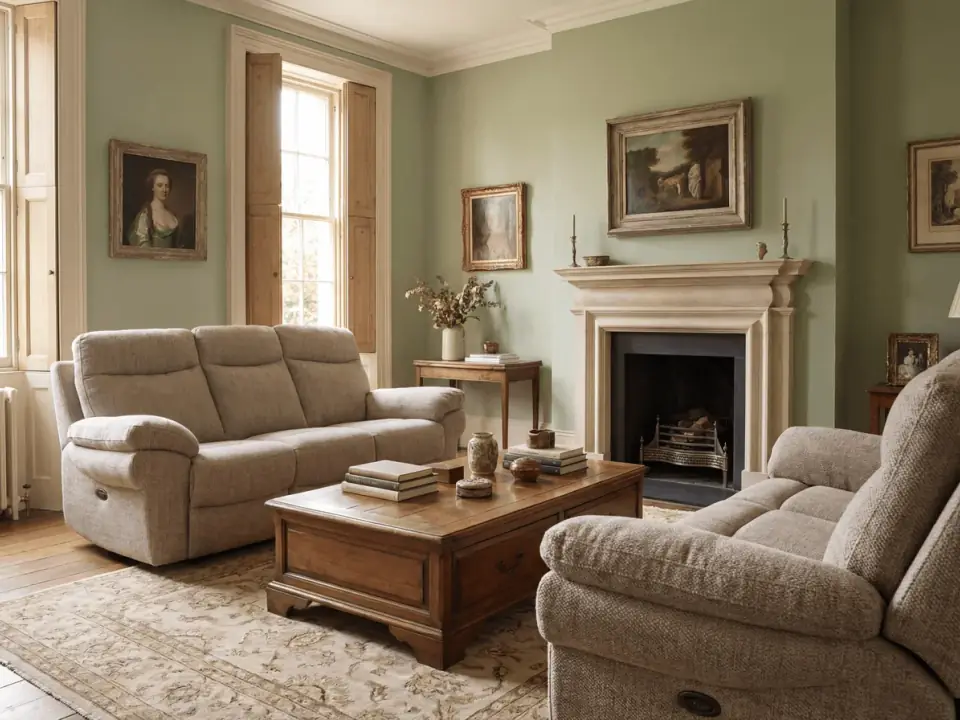
The Tanya Electric Recliner Set
£2,299
A 3-seater and 2-seater electric recliner set in soft brushed fabric. USB charging ports built into each seat, individually-controlled motors for headrest and footrest, and silent linear actuators. Sold as a matching set or split if you prefer.
The Tanya is a 3+2 seater set in brushed fabric with individually-controlled electric recline on every outer seat. Here's what makes it our family pick:
Silent linear actuators. The motors on the Tanya are noticeably quieter than most recliners in this price range. You can recline during a film without the person next to you hearing the mechanism — that's not true of many competitors.
USB charging in every seat. Both the 3-seater and 2-seater have USB ports built into the outside arm of each reclining seat. Phones, tablets, e-readers — everything charges from where you're sitting.
Powered headrest and footrest. The headrest and footrest operate independently, so you can tilt the headrest forward for TV watching while keeping the footrest down, or vice versa. This level of adjustment is unusual at the £2,299 price point — most competitors at this price offer footrest-only recline.
Brushed fabric in Beige or Charcoal. The fabric is soft but hard-wearing — a brushed polyester that resists pilling and cleans easily with a damp cloth. Beige suits lighter rooms; Charcoal works in modern and traditional schemes alike.
At £2,299 for the full set (3-seater + 2-seater), the Tanya undercuts most comparable 3+2 recliner sets from premium UK retailers by £500-£800.
The Cinema Electric Recliner#
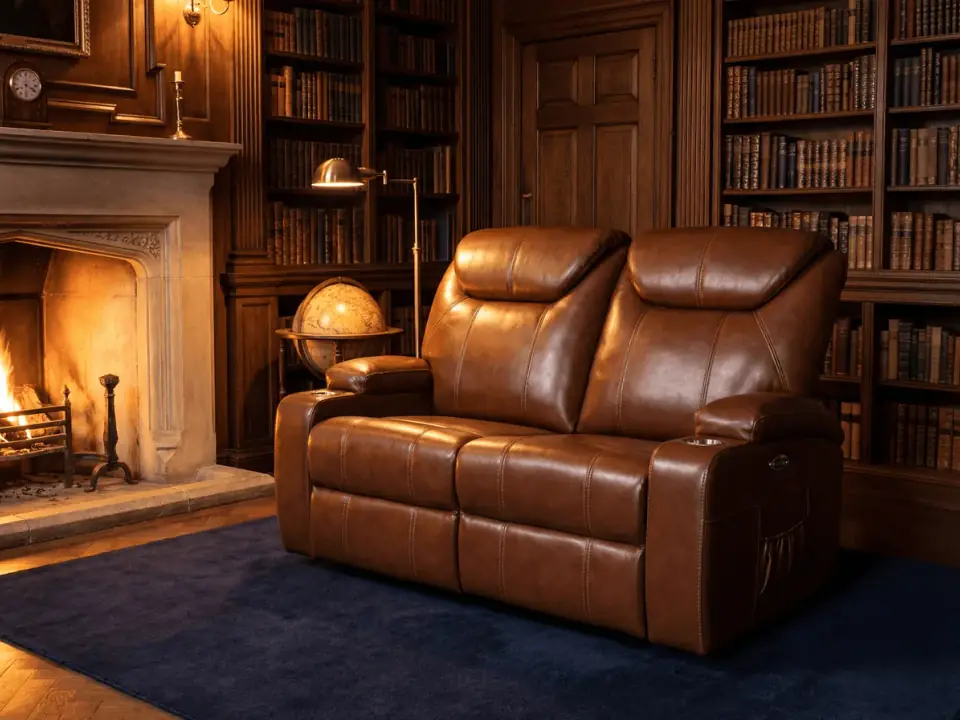
The Cinema Electric Recliner
£1,599
A 2-seater electric recliner in full-grain Italian leather with two integrated cup holders, ambient under-seat lighting, and powered headrest. Designed for true cinema-room comfort. Available in Tan, Black, and Cognac.
The Cinema is a different animal — a 2-seater in full-grain Italian leather with cup holders, ambient under-seat lighting, and a powered headrest. It's designed for one job: making your TV room feel like a private screening room.
Full-grain Italian leather. Not top-grain, not bonded — full-grain. This is the same grade of leather used by premium automotive brands. It will develop a beautiful patina over years of use, and it won't crack or peel. Available in Tan, Black, and Cognac.
Integrated cup holders. Two cup holders built into the centre console between the seats. They're wide enough for standard mugs and tall enough for wine glasses. Trivial-sounding, but once you've used them you'll wonder how you ever watched a film while balancing a drink on the armrest.
Ambient under-seat lighting. A soft LED strip underneath the front edge of each seat. It's subtle — just enough light to find your way to the sofa in a darkened room without tripping over the coffee table. You can turn it off entirely if it's not your thing.
At £1,599 for a full-grain leather 2-seater with these features, the Cinema sits in a competitive space. Equivalent leather recliners from high-street retailers typically start at £1,800-£2,200 for top-grain (not full-grain) leather without the cup holders and lighting.
Both recliners arrive fully assembled — plug into the nearest mains socket and you're done. Free UK delivery in 7-10 days with two-person room-of-choice placement.
Frequently Asked Questions#
How much electricity does an electric recliner use?#
Very little. The motors only draw power when actively reclining — about 50-100 watts for 10-15 seconds per recline cycle. On standby, the transformer draws less than 1 watt. Even with heavy daily use, an electric recliner adds less than £5-£10 per year to your electricity bill.
Can I plug an electric recliner into an extension lead?#
Yes, but use a quality extension lead rated for the transformer's wattage (usually 50-150W). Avoid daisy-chaining multiple extension leads — run a single lead from the wall socket to the transformer. If possible, position the sofa so the transformer can reach a wall socket directly. Cable tidies or clips along the skirting board keep everything neat.
How long do electric recliner motors last?#
Quality linear actuators are rated for 10,000+ full recline cycles. If you recline twice a day, that's nearly 14 years of daily use. In practice, most motors last the lifetime of the sofa. If one does fail, replacement motors cost £40-£80 and can be swapped in about 30 minutes with basic tools.
Do electric recliners work during a power cut?#
No — they need mains power to operate. If a power cut catches you mid-recline, you'll stay in that position until power returns. Some premium models include a battery backup that provides enough power for a few return-to-upright cycles, but this isn't standard. It's worth checking if battery backup is included on your chosen model, particularly if you live in a rural area with occasional outages.
Are electric recliners safe for children?#
Modern electric recliners include pinch-prevention features — the mechanism is designed so that fingers can't get caught between moving parts. However, common sense applies: don't let small children operate the controls unsupervised, and don't let them crawl underneath while someone is reclining. The footrest extends with considerable force and the space underneath closes as it does so. Treat it like any other piece of motorised furniture.
Will a recliner sofa damage my flooring?#
It can, if the feet aren't suitable for your floor type. Hard plastic feet on hardwood or laminate flooring will scratch over time, especially since the sofa shifts slightly with each recline cycle. Fit felt pads to the feet (available from any hardware shop for a few pounds) or ask the retailer for floor-friendly glides. On carpet, standard feet are fine — the pile absorbs the movement.