When a Corner Sofa Bed Is the Smartest Buy#
A corner sofa bed solves two problems with one piece of furniture, and in a country where the average spare bedroom is 2.4 metres wide, that matters more than most people realise until the in-laws announce they are staying the weekend.
The calculation is simple. A standalone sofa plus a guest bed requires two rooms, or at minimum the floor space for both pieces. A corner sofa bed requires one. In a studio flat, a one-bed conversion, or a terrace house where the "spare room" is really the home office, that is not a compromise — it is often the most practical layout available.
But corner sofa beds have a reputation problem. A decade ago, most were genuinely awful: thin mattresses over a metal frame that poked through the cushions, mechanisms that jammed, and seats that sagged within a year. That has changed. Modern corner sofa beds — the good ones — use proper seat-grade foam, pocket-sprung mattresses, and mechanisms a teenager could operate one-handed. The quality gap between the best and worst is still wide, though, and this guide exists to help you land on the right side of it.
How Corner Sofa Beds Work: Pull-Out, Click-Clack and Fold-Down Mechanisms#
The mechanism determines everything: how easy the bed is to deploy, how comfortable it is to sleep on, how long the whole thing lasts, and how much floor space you need to operate it. There are three main types, and they suit very different situations.
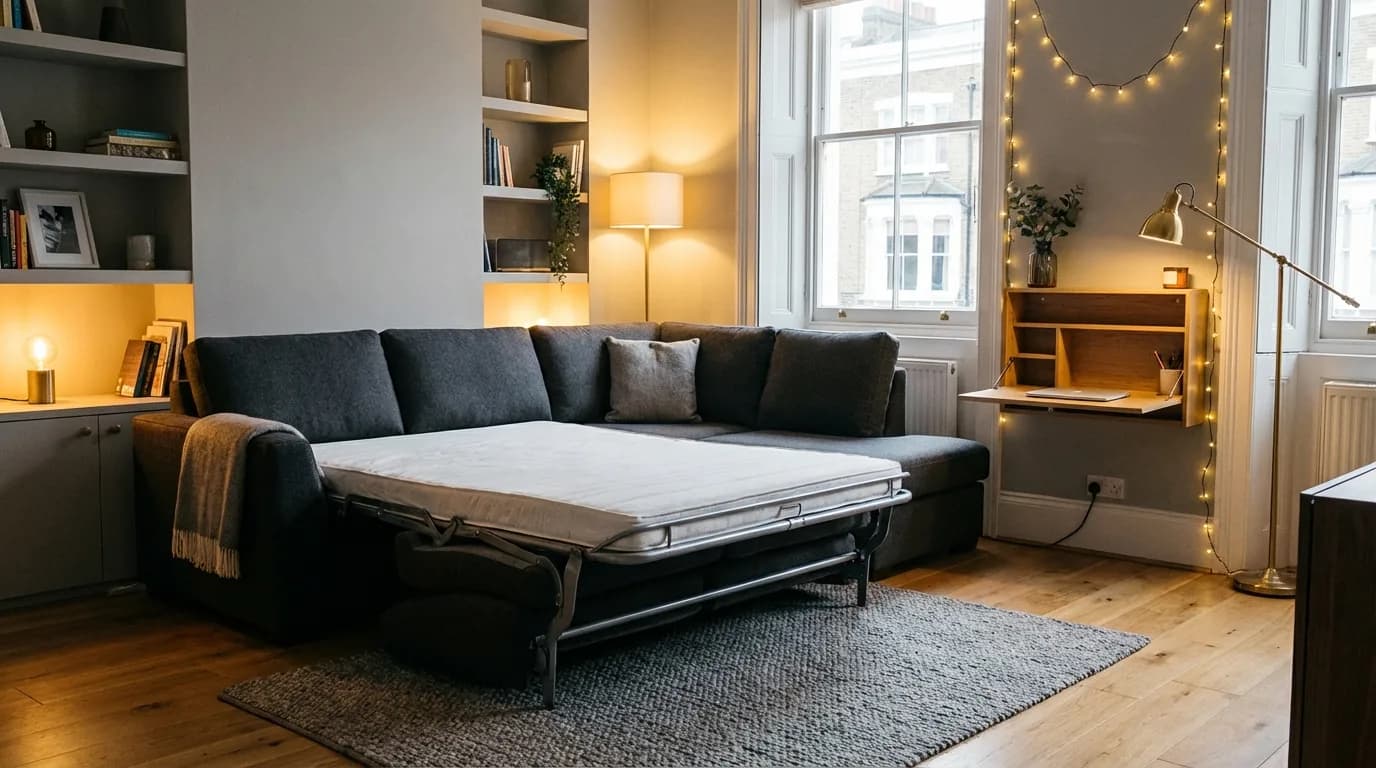
Pull-out (drawer) mechanisms are our top recommendation for anyone hosting guests more than a few times a year. The mattress is completely separate from the seat cushions, so neither function compromises the other. The trade-off is that you need 120-150cm of clear floor space in front of the sofa for the bed to pull out into.
Click-clack mechanisms are the simplest. The seat and backrest click from upright (sofa) to flat (bed) in one motion. They are popular in studio flats because the bed does not extend beyond the sofa's footprint. The downside: you are sleeping on the sofa cushions, and sofa cushions are not mattresses. For occasional use this is fine. For someone sleeping on it weekly, it is not.
Fold-down (book) mechanisms fall in the middle. The seat folds forward and the backrest drops behind it, creating a sleeping surface from both. More comfortable than click-clack because the combined surface is thicker. They need less clearance than pull-outs but more than click-clack.
What Mattress Comes Inside? Foam, Pocket Sprung and Memory Foam Compared#
The mattress inside a sofa bed is where manufacturers cut corners first, so this is where you need to pay the most attention.
Standard foam is the default in budget sofa beds. It is typically 8–10cm thick, medium-density polyurethane foam. For a guest who stays two or three nights a year, it is adequate. For anything more regular, it bottoms out — you feel the frame through the foam, and by morning your back knows about it.
Pocket-sprung mattresses are the gold standard in sofa beds, just as they are in standalone mattresses. Each spring sits in its own fabric pocket and responds independently, so the mattress contours to your body rather than sagging uniformly. A pocket-sprung sofa bed mattress is typically 12–14cm thick and feels meaningfully closer to a real bed. These cost more — expect to add £200–£400 to the sofa price compared to foam — but the difference in sleep quality is immediate.
Memory foam mattresses in sofa beds are less common than you might expect, because memory foam does not fold as compactly as open-cell foam. Where it is used, it is typically a 3–4cm memory foam layer on top of a firmer support foam base. This gives the pressure-relief benefits of memory foam without the folding problem. The one caveat is heat: memory foam sleeps warmer than pocket sprung, which can be uncomfortable in a small room in summer.
Mattress width is another detail people overlook. A standard UK double mattress is 135cm wide. Some corner sofa bed mattresses are only 120cm wide — technically a "small double" — because the mechanism constrains the frame size. Check the actual sleeping dimensions, not just the sofa dimensions. If two adults will be sharing it, 135cm is the minimum. For a single guest, 120cm is generous.
Corner Sofa Bed Sizes: Will It Fit Your Room?#
Corner sofa beds are larger than standard sofa beds because the L-shape adds width. Before you fall in love with one online, you need two measurements: the sofa footprint when closed, and the bed footprint when open.
Typical corner sofa bed dimensions (closed):
- Compact: 230cm x 150cm. Fits a room that is at least 3.5m x 3m.
- Standard: 270cm x 170cm. Needs a room at least 4m x 3.5m.
- Large: 300cm+ x 190cm. Needs a room at least 4.5m x 4m.
When the bed is open, the sofa extends forward by 100–150cm depending on the mechanism. That means your "standard" 270cm corner sofa now occupies 270cm x 290cm — nearly three metres deep. If there is a coffee table in front, it needs to move. If there is a wall 250cm from the sofa front, the bed will not open.
The chaise side matters. Corner sofa beds come in left-hand and right-hand configurations, referring to which side the chaise (the long section) sits on when you face the sofa. Get this wrong and the sofa will not fit your room layout. Stand in front of where the sofa will go, face the wall it will sit against, and note which side has more space — that is your chaise side.
Storage Compartments: The Hidden Bonus#
One of the most underrated features of a corner sofa bed is the storage built into the chaise section. On most models, the chaise seat lifts up on a hinge (or sometimes a gas strut, like a car boot) to reveal a cavity large enough for duvets, pillows, bed linen, and seasonal blankets.
This is not a gimmick. Without chaise storage, guest bedding ends up in a cupboard you do not have, crammed into a wardrobe, or piled on the sofa itself — which defeats the purpose of having a sofa.
What to look for in sofa bed storage:
- Gas-strut lifting is vastly superior to manual hinge lifting. The chaise seat on a gas-strut model stays open on its own while you arrange bedding inside. A manual hinge version drops shut the moment you let go, which means you need one hand holding the seat up and one hand wrestling a duvet into a box, and that is a recipe for swearing.
- Lined interior. Some cheaper models leave the storage cavity as bare chipboard. Better models line it with fabric or felt, which protects your bedding from snags and looks less like you are storing things in a packing crate.
- Depth. A standard chaise storage compartment is 35–40cm deep, which is enough for a folded king-size duvet and two pillows. Shallower compartments (under 30cm) are too tight for bulky bedding.
If storage is a priority — and in a small home it should be — also look at corner sofas with storage that are not sofa beds. The Orka, for instance, offers generous chaise storage without the bed mechanism, which means more storage depth and a simpler design.
Comfort for Everyday Sleeping vs Occasional Guests#
This is the most important distinction in the entire sofa bed market, and most buyers do not think about it until it is too late.
Occasional use means a few times a year — the in-laws at Christmas, a friend after a dinner party, your university-age child back for the weekend. For this, almost any decent sofa bed with a 10cm+ mattress will do. The sleeper is not there long enough for the mattress quality to matter much, and the sofa function is more important because it is used 360 days a year.
Regular use means weekly or more — a flatmate in a studio, a child who sleeps on it every night, a home office that doubles as a guest room three nights a week. For this, you need a pull-out mechanism with a pocket-sprung or hybrid mattress of at least 12cm thickness. Anything less and you will feel the frame, the foam will compress permanently within a year, and the person sleeping on it will resent you.
The seat cushion trap: Some sofa beds use the same foam for the seat and the mattress. This seems efficient until you realise that seat foam and mattress foam have different density requirements. Seat foam needs to be firm enough to support you sitting upright; mattress foam needs to be softer to let your hips and shoulders sink in. A single foam that does both jobs does neither well. The best sofa beds keep these two systems entirely separate.
Fabric vs Leather for Sofa Beds#
The fabric-versus-leather question applies to all sofas, but sofa beds add a specific wrinkle: bedding. You will be draping sheets and duvets over the surface regularly, and whatever material the sofa is upholstered in needs to cope with that.
Fabric sofa beds are the better choice for most people. Fabric breathes, so it does not get clammy under bedding. It grips sheets — they stay in place rather than sliding off. It is warmer in winter and cooler in summer. And fabric is available in a vastly wider range of colours and textures than leather.
The downside of fabric is staining. If your sofa bed is in a living room that sees spilled drinks, muddy dogs, or children with felt-tip pens, fabric needs more maintenance. Look for removable, machine-washable covers if hygiene matters (it should — a sofa bed gets face-to-fabric contact that a regular sofa does not).
Leather sofa beds are easier to clean — a wipe with a damp cloth handles most spills — and they age beautifully if you condition them. But leather is cold to sit on in winter, sticky in summer, and sheets slide off it relentlessly. If you go leather, invest in a fitted sheet with deep elastic corners, or use a mattress protector with a grippy underside.
For sofa beds that double as a regular sofa in a family living room, we would steer you towards a durable woven fabric — something like the fabric on our Orka Corner Sofa — with removable covers. For a home cinema or snug where the sofa bed is secondary to the main seating, leather makes more sense. Our Cinema Recliner is a good reference point for the kind of full-grain leather that ages gracefully.
How to Make a Sofa Bed Actually Comfortable#
We are going to be direct: even the best sofa bed is not as comfortable as a proper bed with a 25cm mattress. The engineering constraints — folding, storing, mechanism clearance — mean the mattress is thinner and the base is less forgiving. But you can close the gap significantly with a few practical moves.
1. Add a mattress topper. A 5–7cm memory foam topper is the single most impactful upgrade. It smooths out the mechanism underneath and adds pressure relief that a thin sofa bed mattress lacks. Roll it up and store it in the chaise compartment during the day.
2. Use proper bedding. A fitted sheet, a proper duvet, and real pillows transform the experience. The fitted sheet also protects the mattress from body oils and sweat, extending its life considerably.
3. Air the mattress monthly. Sofa bed mattresses spend most of their life folded and sealed. Without airflow, moisture builds up and the foam starts to smell. Once a month, open the bed and leave the mattress exposed for a few hours with a window open.
4. Rotate the mattress. Sofa bed mattresses develop impressions just like regular ones. If it is reversible, flip it every few months. If not, rotate it 180 degrees so the head end becomes the foot end.
5. Keep the mechanism clean. Dust, crumbs, and pet hair accumulate in the tracks. Every few months, vacuum inside the sofa frame and wipe the metal rails with a dry cloth. A stiff mechanism is usually a dirty mechanism, not a broken one.
6. Level the sofa. A sofa on an uneven floor — common in older UK homes — means a tilted sleeping surface. Use furniture shims under the feet to level it. A 5mm tilt is barely noticeable sitting but very noticeable lying down.
Frequently Asked Questions#
Are corner sofa beds comfortable enough to sleep on every night?#
It depends entirely on the model. Budget corner sofa beds with thin foam mattresses are not suitable for nightly use — the foam compresses within months and you will feel the frame. Higher-end models with pocket-sprung mattresses of 12cm or more can be used nightly, particularly if you add a quality mattress topper. If someone will sleep on it every night long-term, prioritise a pull-out mechanism with a separate mattress over a click-clack or fold-down design, and budget at least £1,200 for the sofa itself.
What size room do I need for a corner sofa bed?#
For a compact corner sofa bed (230cm x 150cm closed), you need a room of at least 3.5m x 3m with the bed closed. When the bed is open, add 100–150cm to the depth — so that same room needs to be at least 3.5m x 4.2m for the bed to deploy without moving furniture. Always measure with the bed open, not just closed. If the coffee table needs to move every time you open the bed, factor that into your layout planning.
Can I get a corner sofa bed through a narrow doorway?#
Most corner sofa beds arrive in two or three sections, with the largest section typically around 180cm x 90cm. A standard UK internal door is 76cm wide, so the sections usually fit through turned on their side. The problem areas are tight staircases with 90-degree turns and narrow hallways under 80cm wide. Before ordering, ask the retailer for the dimensions of each delivery section and measure your access route — including any turns, banisters, or low ceilings on the stairs.
How long does a corner sofa bed last?#
A well-made corner sofa bed should last 8-12 years. The mechanism is usually the first thing to go -- cheaper models may jam or sag after 3-5 years. The mattress is the second weak point; budget for replacing it (or adding a topper) after 4-6 years. The sofa frame itself, if hardwood or engineered plywood, will outlast both. Avoid particleboard frames -- they do not survive the repeated stress of the mechanism.
What is the difference between a corner sofa bed and an L-shaped sofa bed?#
They are the same thing. "Corner sofa bed" and "L-shaped sofa bed" are used interchangeably in the UK market. Both refer to a sofa with a chaise section forming an L-shape, with a bed mechanism built in. Some retailers also use "chaise sofa bed." The bed mechanism is almost always in the main (non-chaise) section, with the chaise providing storage.
Should I buy a corner sofa bed with storage?#
Yes, if it is available in your budget. Chaise storage is one of the most practical features on any sofa bed, because it gives you a dedicated place to keep guest bedding, pillows, and a mattress topper when the bed is not in use. Without it, you need a separate storage solution — an ottoman, a wardrobe, or a vacuum bag under the real bed — and in a small home, that space often does not exist. Gas-strut assisted lids are worth the premium over manual hinges, as they hold the seat open while you arrange bedding inside.