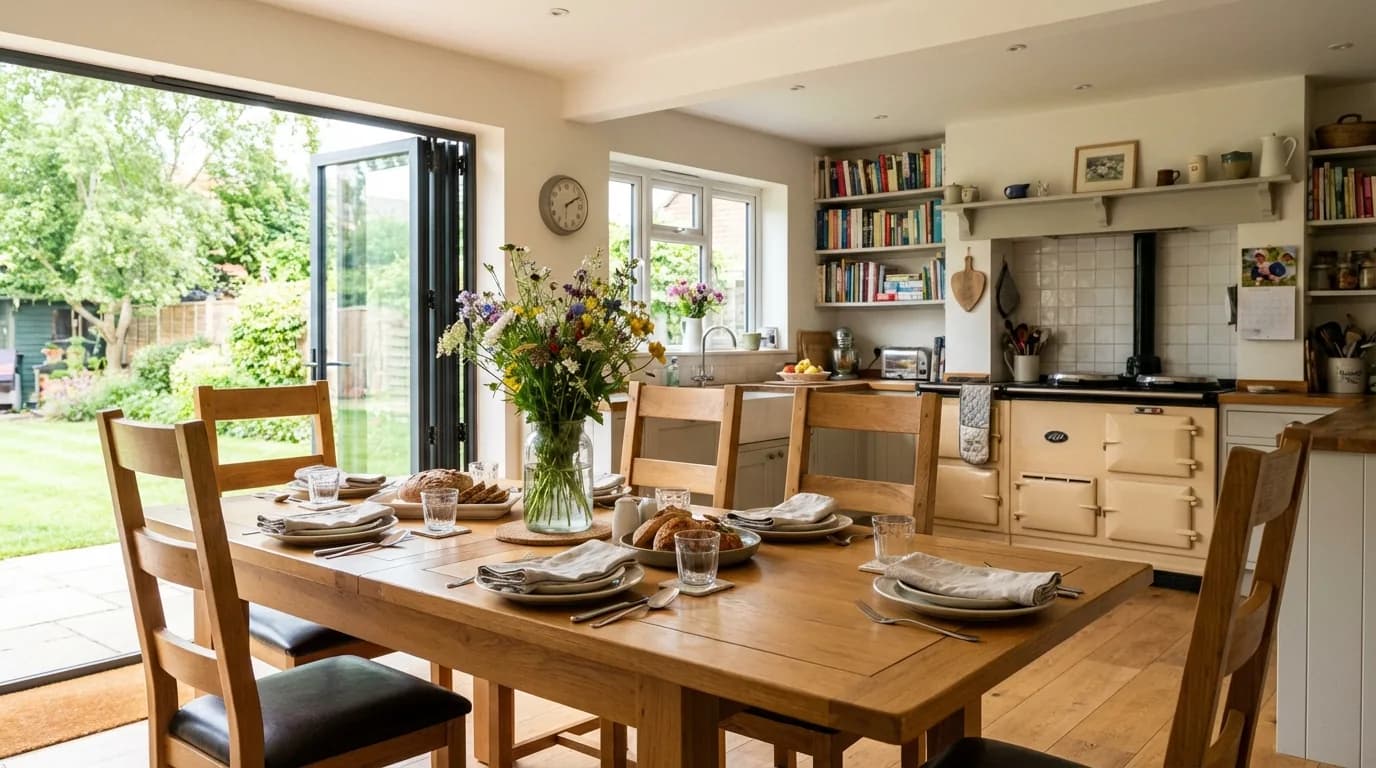
Why the Dining Table Is the Heart of Every Home#
There is a reason estate agents stage the dining table first. It anchors the room. It sets the tone for how a house feels the moment you walk in, and it quietly shapes how a family actually lives — whether that means homework sprawled across it at four o'clock or eight plates of roast lamb on a Sunday afternoon.
We have sold thousands of dining tables over the years, and the single biggest regret we hear from customers is buying one that was too small. The second biggest? Buying one that looked stunning online but wobbled the first time someone leaned on it. This guide exists to stop both of those from happening.
What follows is everything we have learned about choosing the right dining table for a UK home — shape, size, material, fixed versus extending, and how to pair it with chairs without the whole thing looking like a furniture showroom had a nervous breakdown.
Round, Rectangular, or Square? Choosing the Right Shape#
Shape is not just about aesthetics. It changes the way people interact at dinner. A round table forces eye contact — nobody is stuck at the "end" — and conversations flow more naturally because everyone is equidistant from the centre. That is brilliant for four people. It is a disaster for eight, because the table diameter balloons and suddenly you are shouting across three feet of oak.
Rectangular tables are the workhorse of UK dining rooms for a practical reason: our rooms tend to be rectangular too. A 180cm table slips neatly into a standard three-bed semi's kitchen-diner and seats six without anyone elbowing their neighbour. Extend it to 220cm and you seat eight.
Square tables split the difference. They are intimate for two or four, but they do not scale. Once you push past four seats, the proportions become awkward — the person in the middle of each side ends up weirdly far from the corners.
What Size Dining Table Do You Need?#
This is pure arithmetic, and we are going to give you the actual numbers because vague advice like "allow enough room" is useless when you are standing in your kitchen with a tape measure.
The rule: allow 60cm of table width per person. That is the minimum for comfortable elbow room with a side plate and a wine glass. For formal dining — think Christmas dinner with serving dishes down the centre — stretch it to 70cm.
Here is what that looks like for each common seating arrangement:
4-seater: 120cm long x 80cm wide (rectangular) or 100cm diameter (round). This is a weeknight table for a couple or a small family. It fits in virtually any kitchen.
6-seater: 160–180cm long x 90cm wide. The sweet spot for most UK families. A 180cm table gives everyone a generous 60cm each on the long sides, with the two heads of the table as bonus seats.
8-seater: 200–220cm long x 90–100cm wide. Sunday lunch territory. You need a room that is at least 3.2 metres long to fit this plus chairs pushed back.
10+ seater: 260cm+ long x 100cm wide. Grand dining rooms, farmhouse kitchens, or entertaining at scale. These tables are rarely bought as a fixed piece — most people start with a 6-seater that extends.
Measure your room first, then choose the table. We cannot stress this enough. Bring a tape measure. Mark the table footprint on the floor with masking tape. Sit a chair at each end and actually walk around it. If you have to turn sideways to get past, the table is too big.
Dining Table Materials: Oak, Walnut, Pine, Glass and More#
The material you choose determines three things: how the table looks, how long it lasts, and how much maintenance you are signing up for. Here is an honest breakdown.
Solid oak is the material we recommend most often, and it is not close. A well-made oak table survives toddlers, teenagers, and decades of Sunday lunches. The grain develops character over time — small marks and patina that make the table feel lived-in rather than damaged. It responds beautifully to re-oiling, and if something truly catastrophic happens (red wine, a dropped casserole dish), a joiner can sand and refinish the surface for less than you would spend on a replacement.
Pine is tempting on price, but be realistic about what you are getting. Pine is a softwood. It dents if you look at it sternly. If you have young children or you are the sort of person who drops things, pine will show every impact within six months. It suits a rustic cottage where character is the point, but it is not a twenty-year family table.
Glass tables solve a specific problem: making a small room feel bigger. Because you can see through them, they do not visually clog the floor space the way a solid timber table does. The trade-off is noise (cutlery on glass is unpleasant), fingerprints (constant), and the nagging anxiety that someone will crack it. Tempered glass is safe — it crumbles into pebbles rather than shards — but it is still glass.
Fixed vs Extending: When Does an Extending Table Make Sense?#
An extending table makes sense in almost every UK home, and we say that without the slightest commercial bias — it is simply the reality of how British rooms are sized.
The average UK kitchen-diner is roughly 4 metres by 3.5 metres. That is big enough for a six-seater table with good clearance, but it is not big enough for an eight-seater every day. An extending table lets you live with a comfortable six-seater through the week and pull out the extra leaf when guests arrive.
How extending mechanisms work:
The most common type is a butterfly leaf — a panel stored underneath the table that folds up and drops into a gap when you pull the two halves apart. Good butterfly mechanisms operate single-handedly in about ten seconds. Cheap ones jam, sag in the middle, or leave a visible seam. Always test the mechanism before you buy.
Draw-leaf tables have leaves that slide out from under the main top at each end. These are traditional (think old pub tables) and mechanically simple, but they extend the length rather than the width, so you need a room with depth.
Drop-leaf tables have hinged sides that fold down when not in use. These are best for genuinely tiny kitchens where you need the table to shrink against a wall.
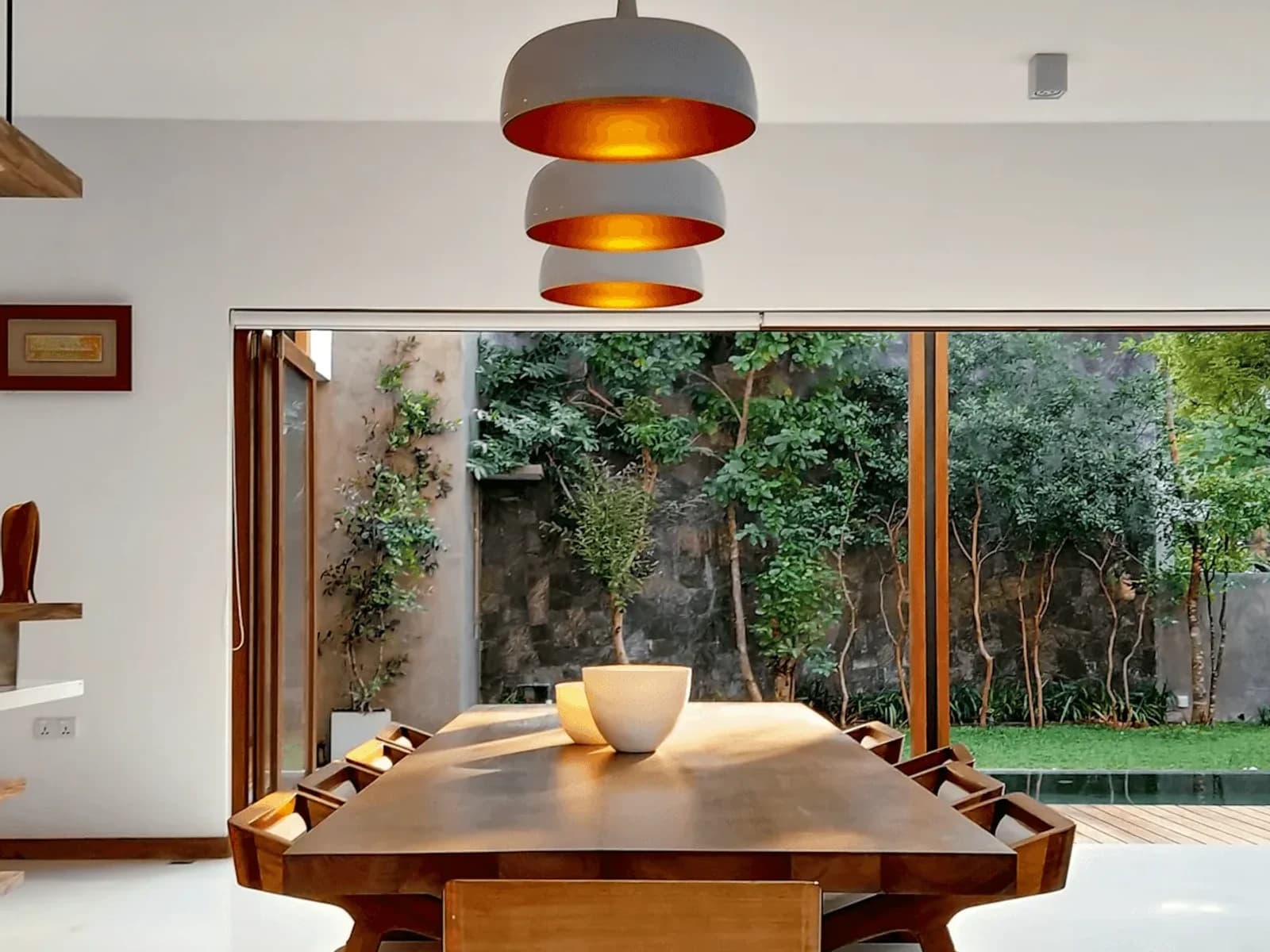
The Hampton Dining Table
£1,299
A solid oak extending dining table that grows with your gatherings. Start as a six-seater for weeknight dinners, extend in seconds to seat eight for Sunday lunch. Hand-finished with natural oils that let the grain breathe, on a kiln-dried hardwood base. Three warm finishes.
Matching Dining Chairs to Your Table#
Chairs are where most people go wrong, and the mistake is almost always the same: they match too literally. A solid oak table with six matching solid oak chairs looks like a catalogue set from 2003. It is stiff, predictable, and — ironically — less stylish than a thoughtfully mismatched arrangement.
The modern approach is contrast. Pair a heavy timber table with lighter chairs — upholstered seats on slim metal legs, bentwood chairs, or even a bench on one side. The visual weight of the table grounds the room while the lighter chairs keep it from feeling like a Tudor banquet hall.
Practical chair considerations:
- Seat height: Standard dining table height is 75cm. Chair seat height should be 43–47cm, giving you roughly 28–30cm of clearance between seat and table top. Measure before you buy, especially if your table is non-standard.
- Armrests: They look elegant but they prevent chairs from tucking under the table. Only buy armed chairs if you have the floor space for them to sit out permanently.
- Upholstered vs hard seat: Upholstered is more comfortable for long meals. Hard seats (wood, metal) are easier to clean and more practical with young children. A good compromise is a hard chair with a removable seat pad.
- Width: Allow 55–60cm per chair. If your table is 180cm long, you can fit three chairs per side with elbow room, or squeeze four if they are 45cm-wide café chairs.
Bench seating is increasingly popular in UK kitchen-diners, and for good reason. A bench on one side seats more people in less space (no gaps between chairs), slides under the table when not in use, and children love them. The downside is that the person in the middle of a bench is trapped — getting up means everyone else shuffles.
Small Kitchen? How to Choose a Dining Table That Fits#
If your kitchen is under 10 square metres, every centimetre matters. Here is how to make it work.
Go rectangular and push one long side against the wall. This is the single most effective space-saving move. A 120cm x 70cm table against the wall functions as a four-seater (three on the open side, one at the end) while only occupying the floor space of a desk.
Consider a round pedestal table. Pedestal bases (a single central column rather than four legs) let you squeeze in extra chairs because there are no legs in the way. A 100cm-diameter pedestal table in a corner seat arrangement can serve four people in remarkably little space.
Wall-mounted fold-down tables are the nuclear option for truly tiny kitchens. They fold flat against the wall when not in use, giving you the full floor back. They are not pretty, but they are effective.
Extending tables in small kitchens work brilliantly — you just need the right type. A draw-leaf or butterfly-leaf table that goes from 120cm to 160cm gives you a two-seater that becomes a four-seater, without permanently occupying the larger footprint.
If you are working with an open-plan kitchen-living room, the dining table does double duty as a room divider. Position it perpendicular to the kitchen counter with the chairs facing the living area, and it naturally separates the two zones without a wall.
Our Pick: The Hampton Extending Dining Table#
We designed the Hampton specifically for the way British families actually eat — six seats for the Tuesday night pasta, eight seats for the Sunday roast, and back to six by the time you have loaded the dishwasher.
The Hampton is built from solid oak — not veneer, not engineered board, but kiln-dried hardwood that will outlast every trend cycle. We hand-finish each table with natural oils that let the grain breathe, so the surface develops a warm patina over the years rather than looking like it has been dipped in plastic.
The extending mechanism is a single-action butterfly leaf. Pull the two halves apart, flip the leaf up, slide together. Ten seconds, one hand, no wobble. The extended surface sits perfectly flush with the main top — no step, no gap, no visible seam.
Three finishes: Natural Oak for a light, Scandi-leaning room; Walnut for depth and warmth; and Ash for something cooler and more contemporary. All three are oiled, not lacquered, so you can re-oil them yourself every year or so with a cloth and a tin of Danish oil.
At £1,299, the Hampton sits in the mid-range for solid oak extending tables. You can spend less on pine or MDF veneer, but neither will last a decade. You can spend more on bespoke joinery, but you will wait months and pay double.
Legs bolt on in under ten minutes with the included Allen key. Free two-person delivery to your room of choice, anywhere in the UK, in 7–10 days.
The Hampton Dining Table
£1,299
A solid oak extending dining table that grows with your gatherings. Start as a six-seater for weeknight dinners, extend in seconds to seat eight for Sunday lunch. Hand-finished with natural oils that let the grain breathe, on a kiln-dried hardwood base. Three warm finishes.
If you are considering an extending table specifically, our dedicated guide to extending dining tables goes deeper into mechanisms, materials, and sizing.
Frequently Asked Questions#
What is the standard height for a dining table in the UK?#
The standard dining table height in the UK is 75cm (approximately 30 inches) from floor to table top. This works with standard dining chairs that have a seat height of 43–47cm. Counter-height tables (90cm) and bar-height tables (105cm) exist but require matching stools rather than chairs. If you are particularly tall or short, some manufacturers offer custom leg heights — it is worth asking.
How much space do I need around a dining table?#
Allow a minimum of 90cm between the table edge and the nearest wall or furniture. This gives enough room for someone to push their chair back and stand up comfortably. In a tight kitchen-diner, you can reduce this to 75cm on sides where people will not be sitting (for example, if one side of the table is against a wall). On the side where you serve from, ideally allow 110cm so you can walk behind seated guests without squeezing.
How do I protect a solid oak dining table?#
Oil or wax your oak table every 6–12 months — more frequently if it gets heavy daily use. Use coasters under hot mugs and glasses (heat rings are the most common damage we see). Wipe spills immediately, especially red wine, beetroot, and anything acidic. For everyday cleaning, a damp cloth and a drop of washing-up liquid is all you need — avoid silicone-based sprays and abrasive cleaners. If the surface does get marked, a light sand with 240-grit paper followed by a fresh coat of oil will restore it.
Is an extending dining table less sturdy than a fixed one?#
A well-engineered extending table should feel just as solid as a fixed one when closed, and nearly as solid when extended. The key is the mechanism. Cheap extending tables use a simple rail system that allows lateral wobble — you will feel it if you press down on the extended section. Better tables use a butterfly or self-storing leaf mechanism with locking rails that eliminate play. Always test an extending table in both positions before buying, and lean on the extended section to check for movement.
Can I mix dining chair styles?#
Absolutely, and we would encourage it. The most visually interesting dining rooms use two or three chair styles that share a common thread — the same seat height, a similar colour palette, or a complementary material. A classic approach is matching chairs on the long sides with a different statement chair (or a bench) at the ends. The only hard rule is that seat heights must match: mixing a 45cm chair with a 50cm chair means someone is eating at chin level.
What dining table shape is best for a small room?#
Rectangular, almost always. A rectangular table pushed against one wall maximises usable floor space in a way that round and square tables cannot. If you have a square room and want a round table, go pedestal-base so there are no legs eating into the limited chair space. Avoid oval tables in small rooms — they offer fewer seats than a rectangular table of the same length and waste the width at the tapered ends.