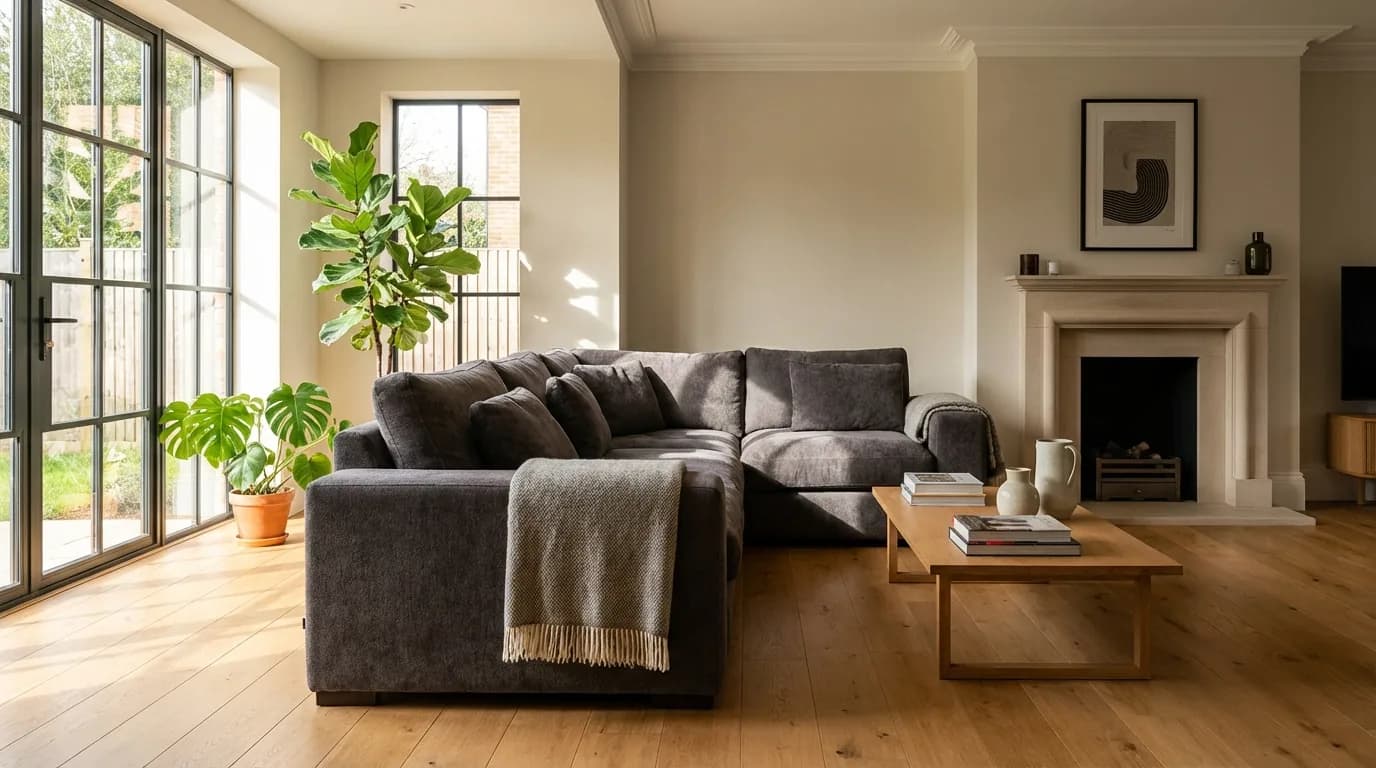
Why Corner Sofas Are Britain's Favourite Seating Choice#
Walk into any furniture showroom on a Saturday afternoon and you will notice the same pattern: couples and families gravitate straight to the corner sofas. There is a reason for that. A well-chosen corner sofa seats more people than a traditional three-seater, anchors an open-plan layout, and eliminates the awkward gap between a sofa and an armchair that collects crumbs, remote controls, and forgotten socks.
In the UK, where the average living room measures around 17 square metres, a corner sofa makes more efficient use of floor space than a separate sofa-and-armchair pairing. Instead of two pieces eating into your walkway, a single L-shape tucks into a corner and frees up the centre of the room. That is not a minor detail when you are trying to fit a coffee table, a TV unit, and a toddler's play mat into the same space.
Corner sofas also solve the "who sits where" problem. With a long chaise on one side, everyone gets a decent seat without the territorial standoff over the only comfortable armchair. Film nights, Sunday afternoon naps, family gatherings — a corner sofa handles them all without rearranging the furniture.
L-Shape vs U-Shape: Which Layout Is Right for Your Room?#
The two main corner sofa configurations are L-shape and U-shape, and choosing the wrong one is a costly mistake.
L-Shape Corner Sofas#
An L-shape is the classic: two sections meeting at a right angle, forming an "L" when viewed from above. This is the most popular configuration in UK homes because it works in rooms as narrow as 3 metres wide. The shorter arm typically sits along the wall, and the longer chaise extends into the room to create a natural boundary between living and dining zones in an open-plan layout.
Seating capacity is usually four to five adults. If you need occasional overflow seating, a pouffe or floor cushions at the open end of the L work well without blocking the walkway.
U-Shape Corner Sofas#
A U-shape adds a third section, closing the gap to form a horseshoe. This creates an enclosed, sociable seating area — brilliant for large families or anyone who entertains regularly. You will need a room at least 4 metres wide and 4 metres deep to accommodate a U-shape without it overwhelming the space.
Seating capacity is six to eight adults. The trade-off is that U-shapes are harder to deliver (three large sections) and more expensive. They also limit furniture placement because the enclosed layout leaves less floor space for side tables or floor lamps.
If your room is between 3 m and 4 m wide, stick with an L-shape. A U-shape in a tight room creates a "pit" feeling that makes the space look smaller than it is. Save U-shapes for rooms over 20 square metres.
How to Measure Your Room for a Corner Sofa#
Getting the measurements wrong is the single most common reason people return corner sofas. Follow these steps and you will avoid the headache.
Step 1: Measure the Two Walls#
Stand at the corner where the sofa will sit. Measure the length of each wall from the corner to the point where you want the sofa to end. Write both numbers down — you will compare these against the sofa's dimensions later.
Step 2: Allow for Walkway Clearance#
Leave at least 60 cm between the front edge of the sofa and any furniture opposite it (coffee table, TV unit, or opposite wall). In a high-traffic area — say, the path between the kitchen and the back door — increase that to 90 cm. People need to walk past without stepping over legs.
Step 3: Mark the Footprint on the Floor#
Use masking tape or newspaper to outline the sofa's footprint on the floor. Live with it for a day. Sit on a chair in the middle of the taped area and check sightlines to the TV, the window, and the door. This five-minute exercise catches problems that no amount of tape-measure work reveals.
Step 4: Measure Your Doorways, Hallways, and Stairwells#
This is the step people skip — and regret. Measure every doorway, hallway turn, and stairwell between your front door and the living room. A corner sofa arrives in two or three sections, and each section typically measures 140-180 cm long, 90-100 cm deep, and 75-90 cm tall.
If any doorway is narrower than 75 cm, or any stairwell turn is tighter than 100 cm, ask the retailer about the exact dimensions of each section before ordering. Delivery teams cannot disassemble most corner sofas on site.
Step 5: Check the Sofa's Listed Dimensions Against Your Measurements#
Compare the sofa's width (wall-to-wall along the long side), depth (front-to-back of the chaise), and height. The height matters for positioning under a window — a sofa taller than the window sill will block light and look odd.
Corner Sofa Fabrics: What Works Best?#
Fabric choice affects how your corner sofa looks, feels, and survives daily life. Here is a quick comparison of the most popular options:
For a deep dive into every fabric type — including Martindale rub ratings, stain resistance, and pet-friendliness — read our full sofa fabric guide.
The most practical choice for a busy UK household is a mid-weight polyester blend in a mid-tone colour (grey, oatmeal, or sage). It hides everyday marks, cleans easily, and holds its shape for years. If you want velvet, go for a polyester velvet — it is far more forgiving than silk or cotton velvet, and the short pile actually repels pet hair rather than trapping it.
Left-Hand vs Right-Hand Corner: What Does It Mean?#
This catches out more buyers than any other specification. The terminology is simple once you know the rule, but it is the opposite of what most people assume.
The rule: Stand facing the sofa as if you are about to sit down. If the longer chaise section is on your right, it is a right-hand corner (RHC). If the chaise is on your left, it is a left-hand corner (LHC).
That is it. You are always facing the sofa, never sitting on it, when determining the hand.
Why Does It Matter?#
If you order the wrong hand, the chaise will extend into your walkway instead of tucking against the wall. In most UK living rooms, the front door or hallway entrance is on one side of the room, dictating which hand you need. The chaise should point away from the main entrance to keep the walkway clear.
Stand in your living room doorway and look towards the corner where the sofa will sit. If the wall continues to your right, you need a right-hand corner. If it continues to your left, you need a left-hand corner. Sketch it on paper if you are unsure — a two-minute drawing prevents a two-week return process.
What to Look for in a Quality Corner Sofa#
Not all corner sofas are built the same. Here is what separates a sofa that lasts a decade from one that sags within two years.
Frame#
A solid hardwood frame (kiln-dried beech, birch, or oak) is the gold standard. Softwood (pine) frames are acceptable at budget price points but flex more under load. Avoid particleboard or MDF — these are used in the cheapest sofas and will crack at the joints within a few years.
Check the corner joints specifically. Corner sofas bear more lateral stress than straight sofas because people lean against the chaise. Dowelled, screwed, and glued joints are the strongest combination. Stapled-only joints are a red flag.
Suspension#
The suspension system sits between the frame and the cushions. There are three common types:
- Sinuous (serpentine) springs — S-shaped metal wire stretched across the frame. The industry standard for mid-range sofas. Look for 8-gauge or 9-gauge wire; thinner gauges sag faster.
- Pocket springs — Individual springs in fabric pockets, similar to a mattress. More expensive but more responsive and longer-lasting. Found in premium models.
- Elastic webbing — Woven bands stretched across the frame. Common in Scandinavian designs. Comfortable initially but stretches over time. Replace every 5-7 years.
Cushion Fill#
- Foam only — Most affordable. Loses shape quickest. Look for high-resilience (HR) foam with a density of at least 30 kg per cubic metre.
- Foam wrapped in fibre — Better shape retention and a softer sit. The fibre layer prevents the "sitting on a block" feeling.
- Foam core with feather-and-down wrap — The most comfortable and expensive option. Requires regular plumping. If you do not enjoy fluffing cushions weekly, avoid pure feather fills.
How to Style a Corner Sofa in Your Living Room#
A corner sofa is a large piece of furniture. Getting the styling right prevents it from dominating the room.
Anchor With a Rug#
Place a rug large enough that the front legs of the sofa sit on it. This visually grounds the seating area and stops the sofa from looking like it is floating. In a room with hard flooring, the rug also absorbs sound and adds warmth. A 200 cm by 300 cm rug works for most L-shape corner sofas.
Balance the Chaise Side#
The chaise end of a corner sofa can look bare without something to balance it visually. A floor lamp, a tall plant, or a slim side table at the open end of the chaise creates a finished look. Avoid placing a large piece of furniture (bookcase, sideboard) directly opposite the chaise — it crowds the sightline.
Layer Your Cushions#
A corner sofa has a lot of backrest to work with. Use an odd number of scatter cushions (five or seven) in two or three complementary tones. Place the largest cushions at the corners and the smallest in the centre. Avoid matching every cushion to the sofa colour — contrast in texture or tone adds depth.
Mind the Coffee Table Proportions#
A coffee table should be roughly two-thirds the length of the sofa's longest section. For an L-shape corner sofa with a 250 cm main section, look for a coffee table around 120-150 cm wide. A table that is too small looks lost; one that is too large blocks the walkway.
Our Pick: The Orka Corner Sofa#
We designed the Orka to address the most common complaints we hear about corner sofas: too deep for short people, too shallow for tall people, and too heavy to rearrange.
The Orka uses a medium-depth seat (55 cm) that suits most body types without needing back cushion rearrangement. The frame is kiln-dried hardwood with sinuous spring suspension, and the cushions are high-resilience foam wrapped in conjugated fibre for a soft but supportive sit.
At 280 cm on the long side and 210 cm on the short side, it fits comfortably in rooms from 3.2 metres wide. The grey fabric is a durable polyester blend rated at 35,000 Martindale rubs — plenty for a family home with pets.
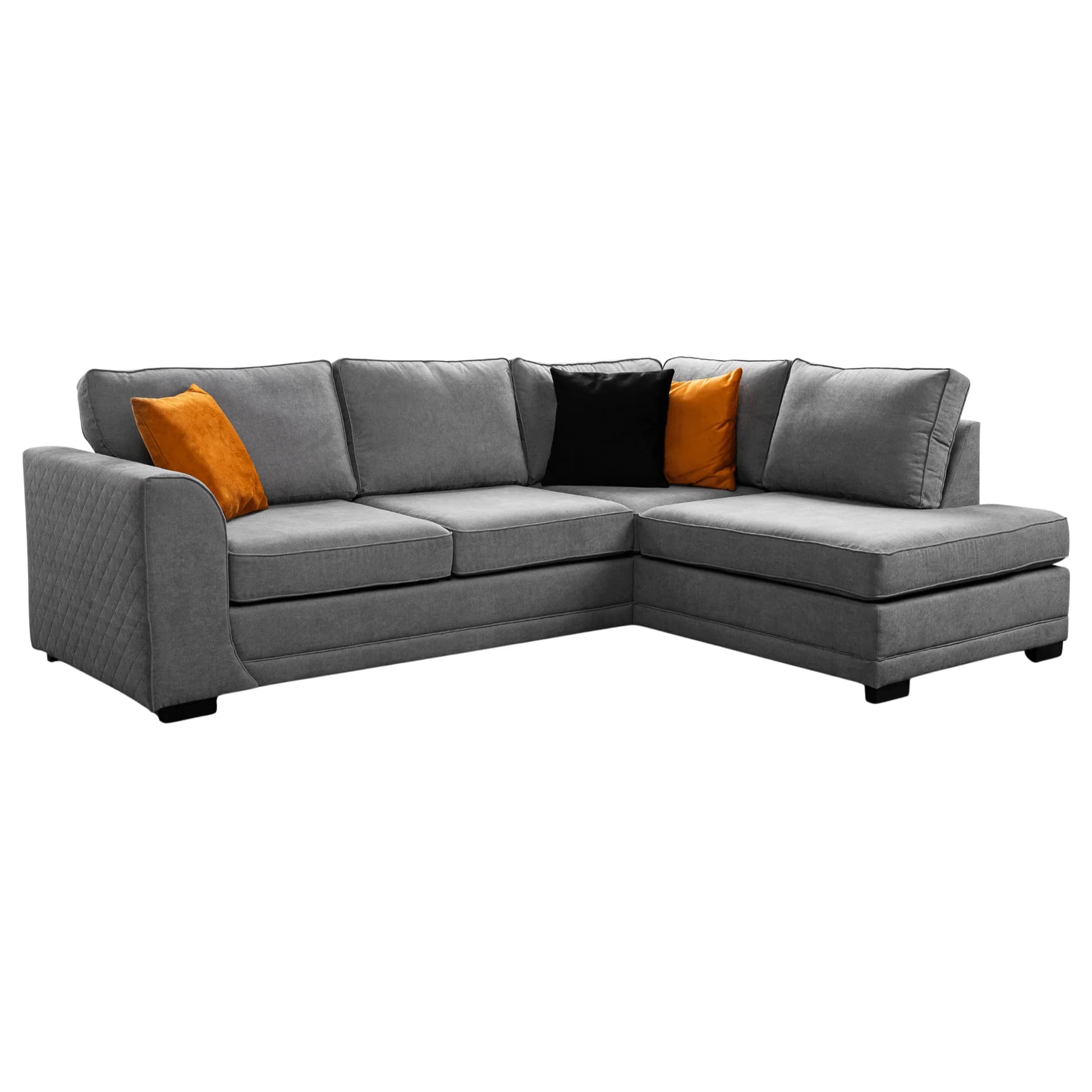
The Orka Corner Sofa
£1,899
A generous L-shaped corner sofa hand-built in our UK workshop. Premium woven fabric across a kiln-dried hardwood frame with high-resilience foam seats and feather-mix backs. Right-hand chaise as standard, left-hand on request. Choose from three signature colours.
The Orka is available as a right-hand corner. If you are also considering a sofa with built-in recline, take a look at our Tanya Electric Recliner Set or our Cinema Recliner — both pair well with a corner sofa in larger living rooms.
Corner Sofa Care and Maintenance#
A corner sofa is a significant investment. Treat it properly and it will look good for a decade or more.
Weekly Maintenance#
- Vacuum the cushions and crevices with an upholstery nozzle. Corner sofas have more joints and gaps than standard sofas, so crumbs and pet hair accumulate faster.
- Plump fibre-wrapped or feather-filled cushions by hand. Stand them on end and karate-chop the top to redistribute the fill. Foam-only cushions do not need plumping.
- Rotate loose seat cushions. Most corner sofas have two or three seat cushions on the main section. Rotate them weekly so they wear evenly.
Monthly Maintenance#
- Wipe down the frame and feet with a damp cloth. Dust builds up on sofa legs and is visible on light-coloured carpets.
- Check all connecting bolts and brackets. Corner sofas join at a bracket underneath. Vibrations from sitting and standing can loosen these over time. A quick hand-tighten every month prevents the sections from separating.
Dealing With Stains#
Act fast. Blot (never rub) liquid spills with kitchen paper immediately. For specific stain types and a step-by-step deep-cleaning method, see our detailed guide on how to clean a fabric sofa.
Professional Cleaning#
Book a professional upholstery clean every 12 to 18 months. Professional cleaning reaches deep into the suspension layer where household vacuums cannot. Expect to pay between 80 and 150 pounds for a corner sofa, depending on size and fabric type.
If your corner sofa has removable covers, check whether they are machine-washable before sending them to a professional cleaner. Machine-washable covers at home can save you 50-70 pounds per year in cleaning costs.
Frequently Asked Questions#
How do I measure my room for a corner sofa?#
Measure the two walls where the sofa will sit, leaving at least 60 cm clearance for walkways. Mark the footprint on the floor with masking tape before ordering so you can visualise the fit. Remember to measure doorways and stairwells too — your sofa needs to get into the room.
What is the difference between an L-shape and a U-shape corner sofa?#
An L-shape has two arms forming a right angle, ideal for rooms from 3 m wide. A U-shape adds a third section, creating an enclosed seating area best suited to larger open-plan spaces of 4 m or more. U-shapes seat six to eight people comfortably versus four to five for a standard L-shape.
Which fabric is best for a corner sofa with pets?#
Tightly woven fabrics like microfibre or performance velvet resist pet hair and claws better than loose weaves. Look for fabrics rated above 25,000 Martindale rubs for durability. Removable, machine-washable covers are the most practical choice for pet owners. Our sofa fabric guide covers this in more detail.
How long does delivery take for a corner sofa in the UK?#
Stock items typically deliver within one to two weeks. Made-to-order corner sofas take six to ten weeks depending on the manufacturer. At SofaFlow we offer free delivery on all orders, including two-person room-of-choice placement.
Can I return a corner sofa if it does not fit?#
Most UK retailers offer a 14-day return window under the Consumer Contracts Regulations 2013, though bulky-item return shipping can cost between 50 and 150 pounds. Always check the retailer-specific return policy before purchasing, and measure carefully to avoid the hassle.
Are corner sofa beds worth considering?#
If you regularly host overnight guests, a corner sofa bed is one of the most space-efficient solutions available. The best models use a pocket-sprung or memory-foam mattress that genuinely works for nightly sleeping. We cover mechanisms, mattress thickness, and storage in our corner sofa beds guide.